
As soon as Iran blocked the Strait of Hormuz we started hearing about how disastrous it was going to be not just for our economy, but for the whole world.
Around 20% of the world’s oil and LNG was stopped dead in its tracks, so higher energy costs would find their way into everything we buy. Fertilizer supply disruptions would cause food prices to go up. Helium shortages threatened semiconductor manufacturing. Sulphur supply constraints would mean we can’t process copper. On and on it went.
It looked really ugly, and still does, since the war appears far from settled.
And yet, while financial markets did react, they did not react nearly as severely as many expected.
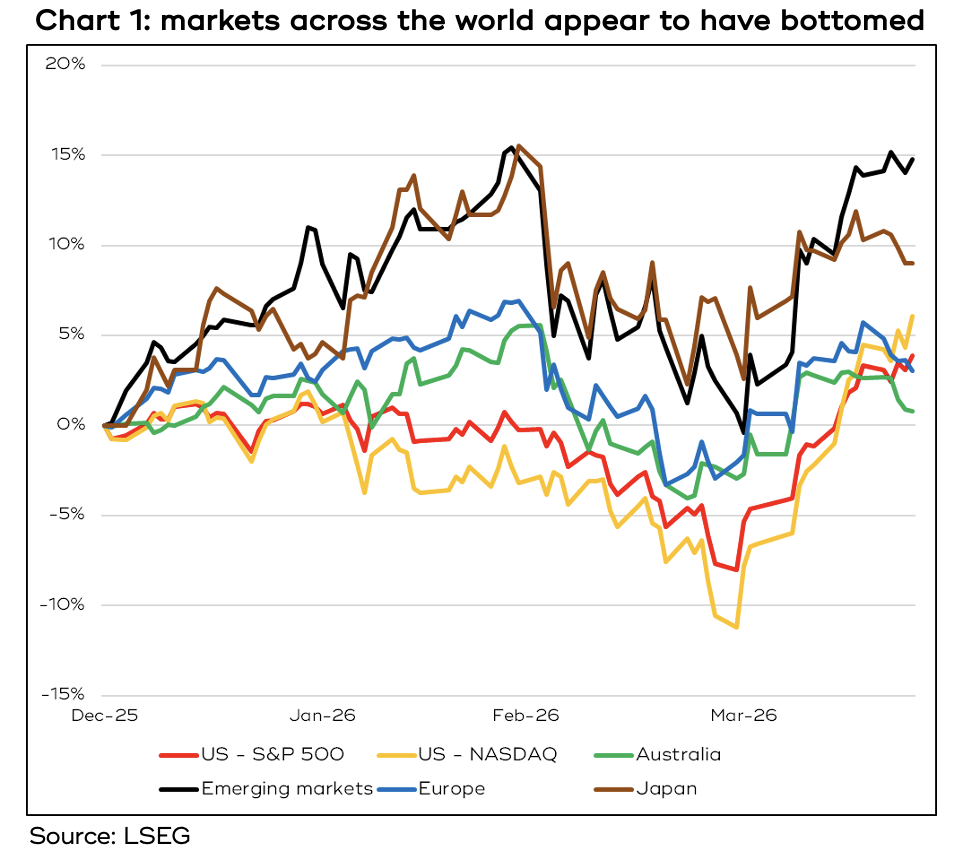
At its worst, the US’s S&P 500 was down about 9% and is now back at all-time highs. Markets everywhere appear to have bottomed and are headed upwards – see chart 1.
How does that make sense?
The simple answer is that markets have been weighing two competing forces:
- The probability of worst-case economic disruption began to fall, even while headlines remained alarming.
- The earnings outlook — particularly in the US — continued to improve.
That combination helps explain why markets proved more resilient than many expected.
Markets discount probabilities, not newspaper headlines
It is worth remembering that markets do not wait for uncertainty to disappear. They move when the direction of uncertainty begins to improve; when things look less bad than what they did previously.
While the Strait of Hormuz closure looked catastrophic on paper, markets increasingly concluded the most severe scenarios — prolonged global supply paralysis or a deep recession — were less likely than initially feared.
Earnings still drive markets
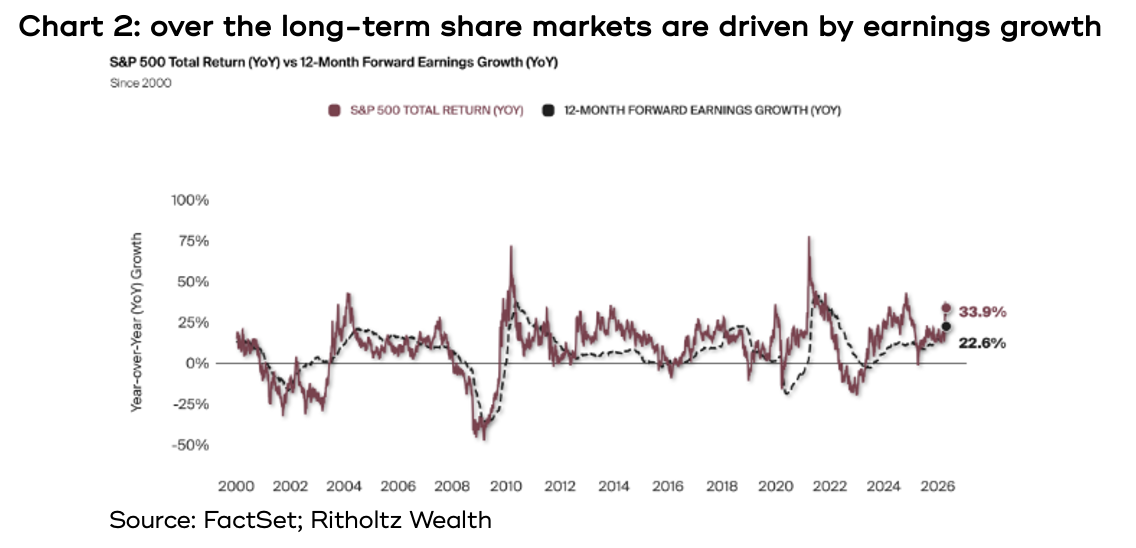
Chart 2 is another reminder of something we talk about a lot: over the short-term share markets can be influenced by sentiment, but over the long-term they’re driven by earnings growth.
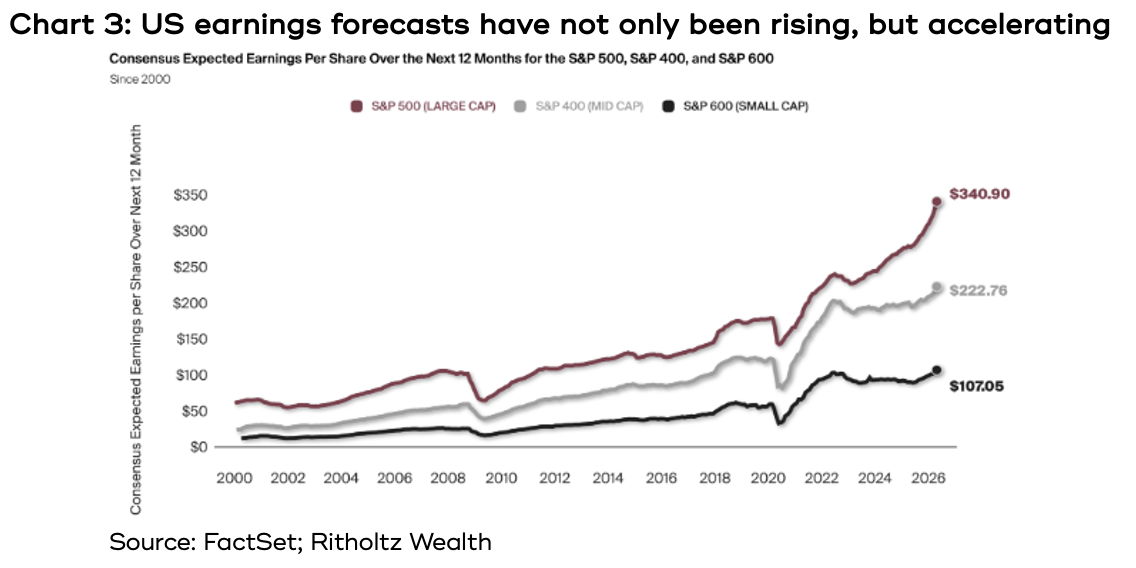
And earnings forecasts, at least in the US, have not only been rising, they’ve been accelerating, especially for the large cap companies – see chart 3.
In fact, during the period when the S&P 500 declined by roughly 9%, forecast earnings rose by a similar amount – see chart 4.
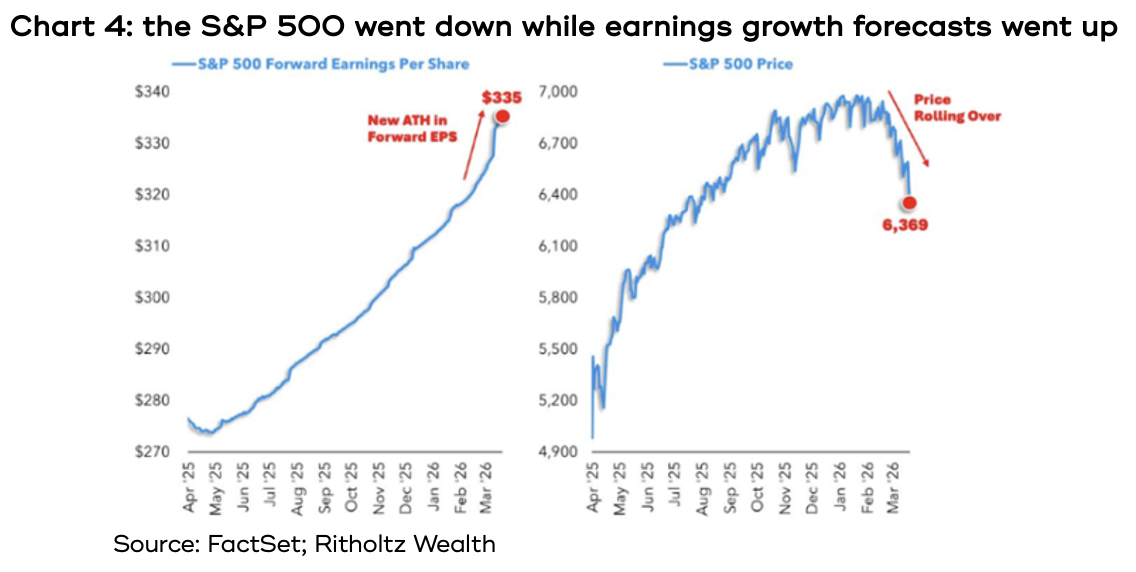
That led to something unusual: the combination of falling share prices while earnings increased meant the market’s price to earnings (PE) ratio, which is the most basic measure of how cheap or pricey the market is, fell by about 18%, something that doesn’t happen very often – see chart 5.
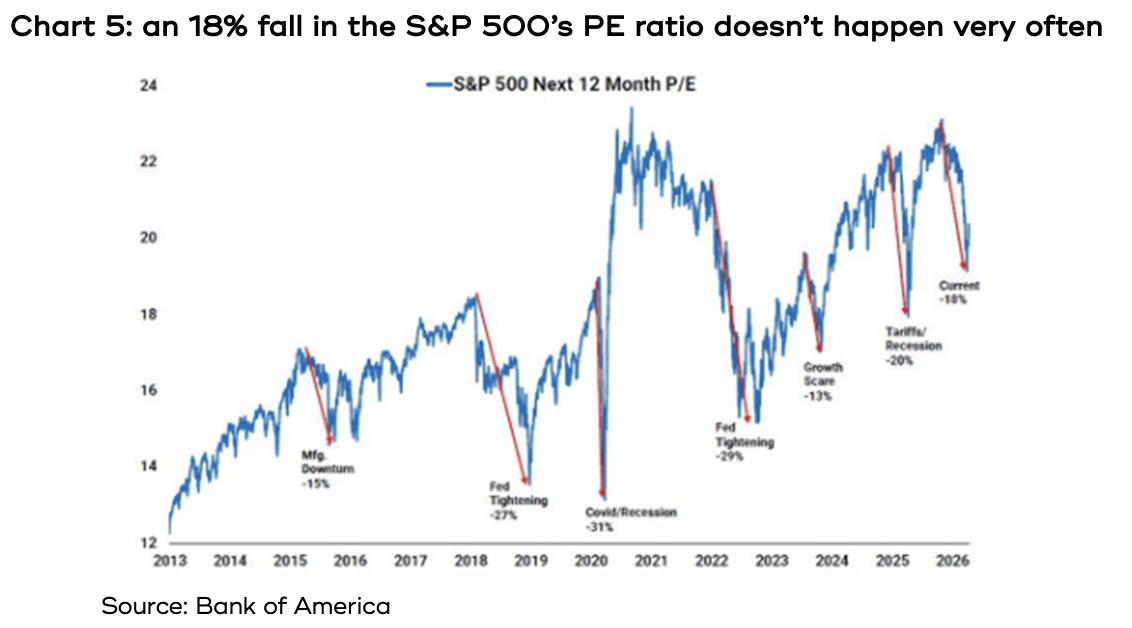
That sharp resetting of valuations at a time of rising earnings forecasts made for a supportive backdrop to a share market recovery.
Once the market concluded the worst threats of the Iran war are behind us, it rebounded sharply. In fact, the S&P 500 shot up by 12.3% in 13 days, the second fastest rebound rally since 1950.
Why tech led the recovery
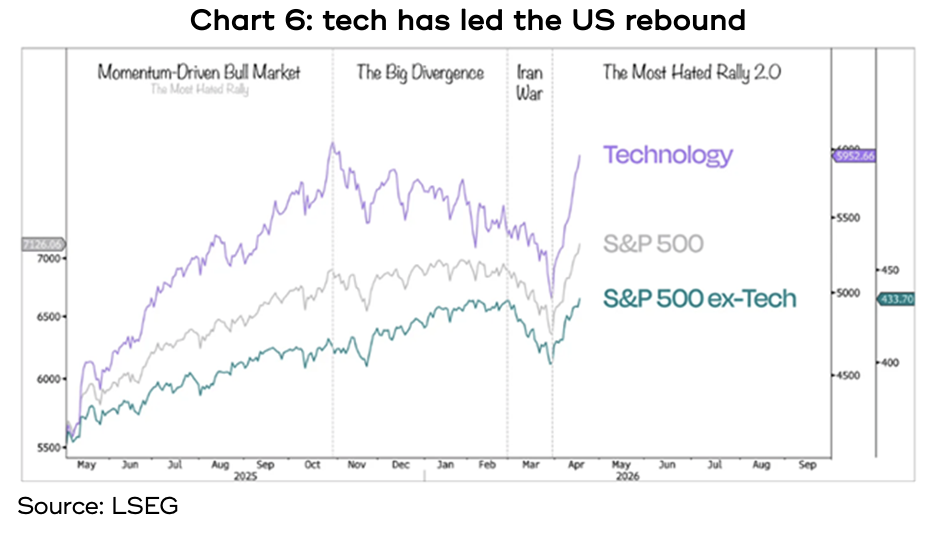
The most interesting part of the US market has been the technology sector, especially so-called Magnificent 7, which is the group of seven giant US growth companies (Apple, Amazon, Google, Meta, Microsoft, Nvidia, and Tesla). Of the 271-point decline in the S&P 500, the Mag7 accounted for 165. Their valuation relative to the broader market reached its cheapest level in more than a decade.
Then the rebound set in, and tech has led the recovery – see chart 6.
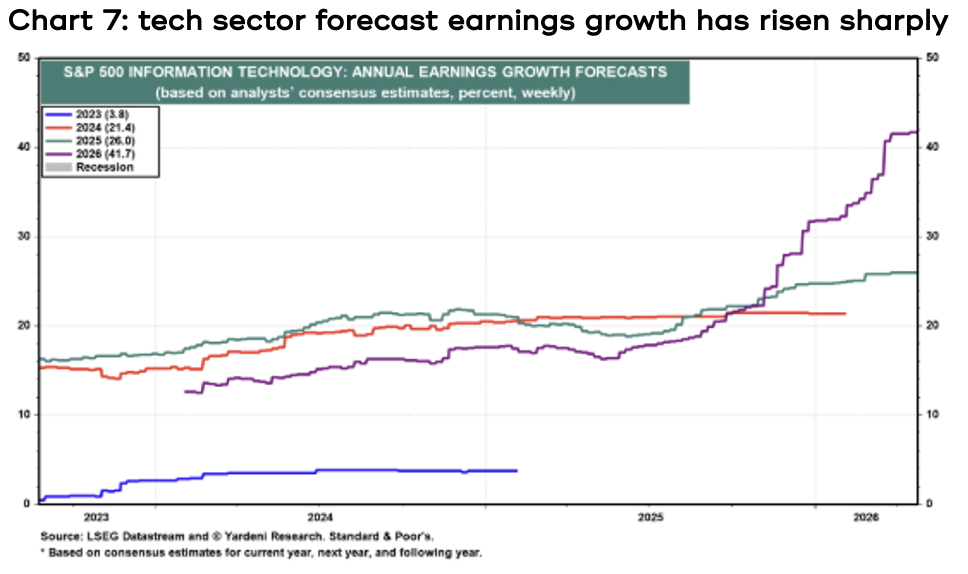
Not surprisingly, it’s also the tech sector that has seen the sharpest increase in forecast earnings growth, even while the Iran War is going on – see chart 7.
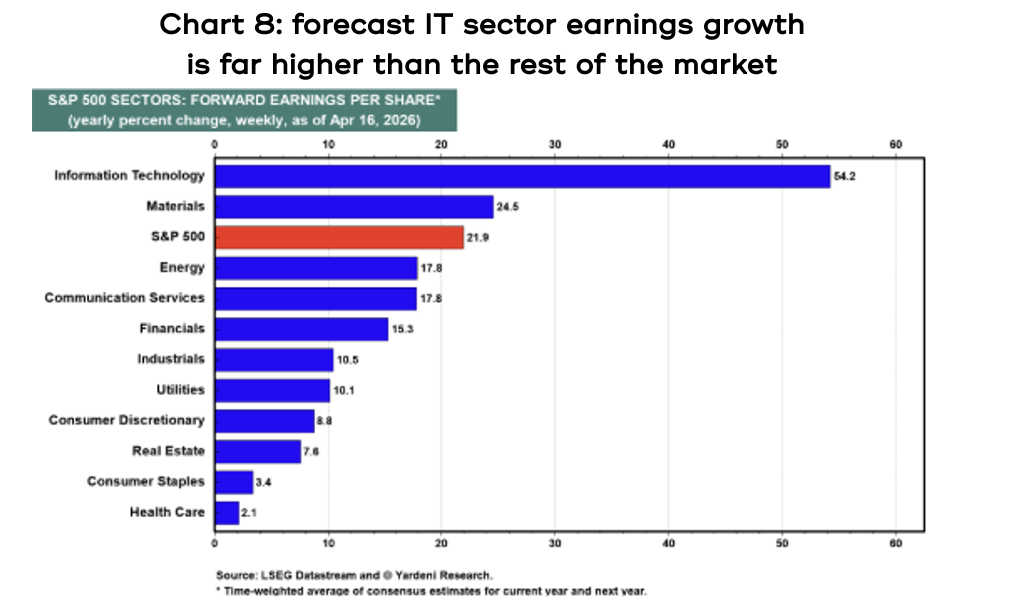
To the point where forecast IT earnings for the next 12 months is more than double the next strongest sector – see chart 8.
The AI investment cycle may be bigger than the war
Not all tech shares have rallied. The sector’s rise has been driven by the hardware side, while software is struggling – see chart 9, and that provides a big clue as to what’s going on.
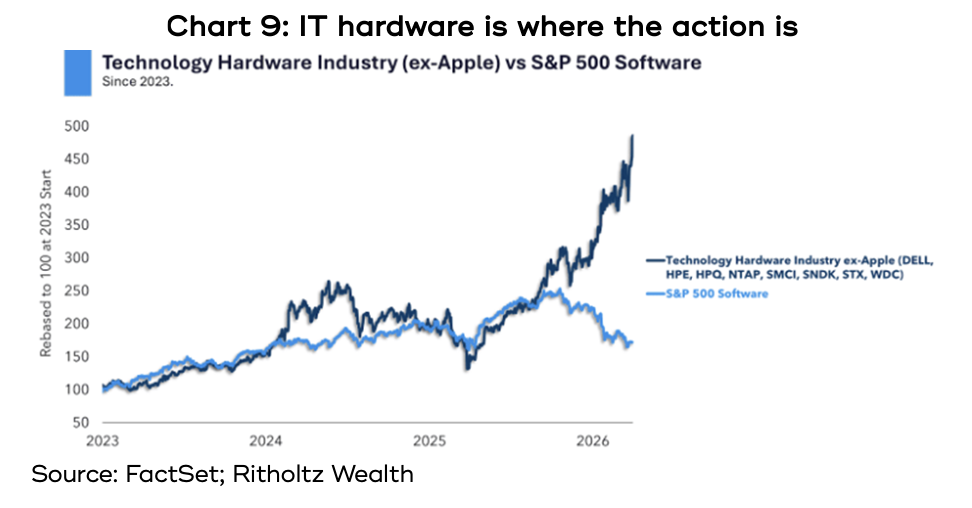
What appears to be supporting both the technology sector and broader earnings growth is a once-in-a-generation capital spending cycle tied to artificial intelligence
AI capex in the US this year is forecast to reach roughly US$700 billion, and globally about US$1 trillion – see chart 10.
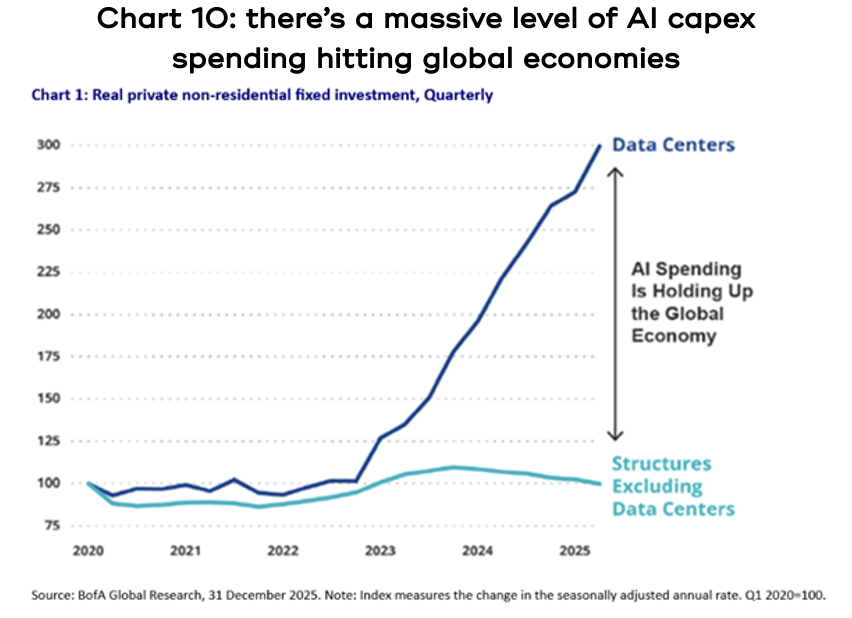
That’s like a huge fiscal injection into the global economy that doesn’t mysteriously disappear down some big hole, but bounces around from business to business: the companies that provide the chips to power the AI (Samsung shares are up 404% in the last 12 months); do the earthworks to build the data centres (Caterpillar shares are up 184%); or provide civil works (Sterling Infrastructure +240%); or power infrastructure (Quanta +120%); or gas turbines (GE Vernova +243%); or air conditioning systems (Comfort Systems +387%); or electrical contracting (Emcor +127%). You get the picture.
It’s entirely possible markets would have fallen further if not for that wave of spending. That may sound ambitious, but the evidence is increasingly compelling. The companies that own the two most popular AI models, OpenAI with ChatGPT, and Anthropic with Claude, are the fastest ever companies to reach a combined US$50 billion in annual recurring revenue – see chart 11.
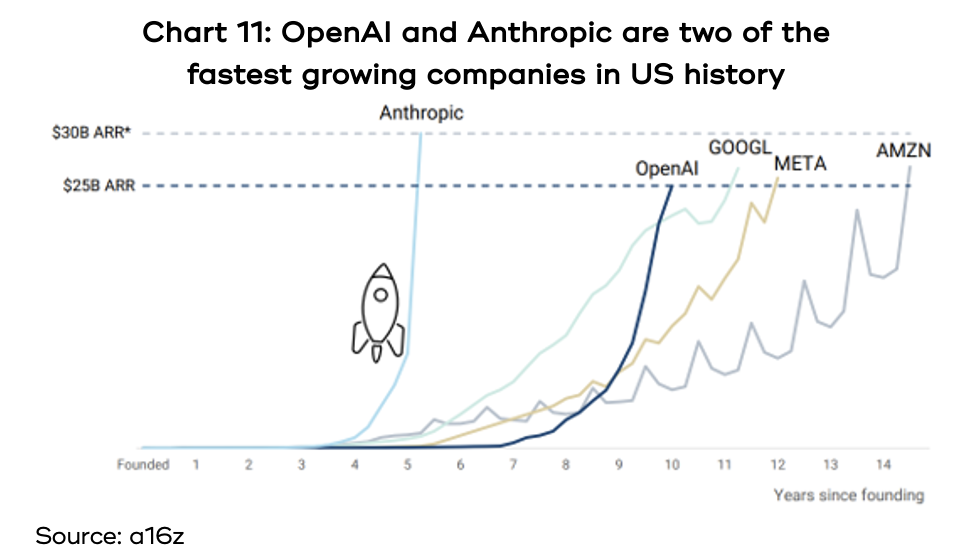
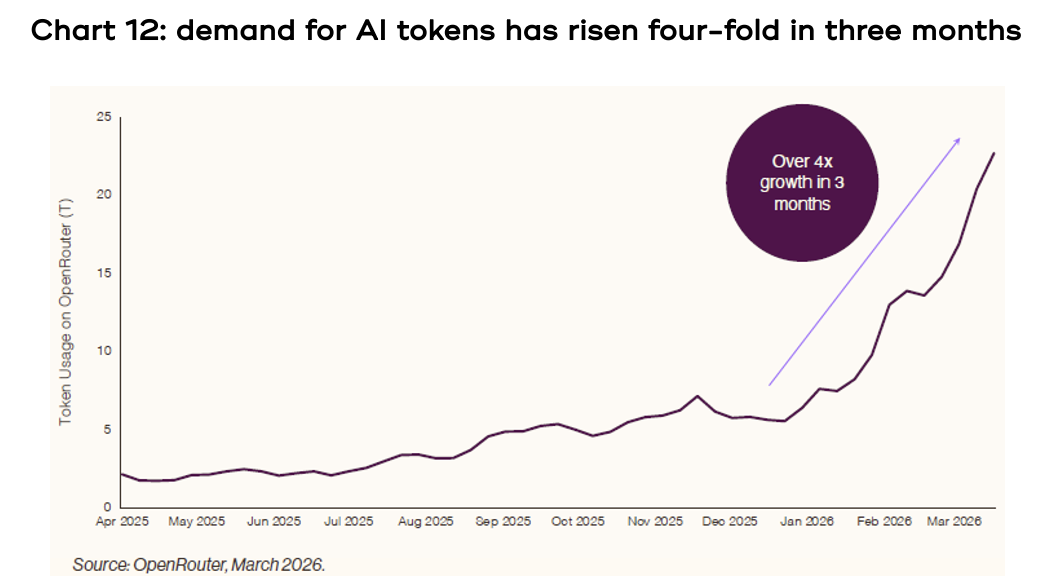
That rocketing revenue growth reflects real demand for AI, with demand rising four-fold since the start of the year – see chart 12.
Markets often recover before the news improves
There remain plenty of sceptics about the share markets’ rebound, which is fair enough, they may well tumble again if the Iran War worsens materially.
But it is worth remembering how often markets turn before the news does.
Share markets bottomed in March 2020, while COVID vaccine results were not announced until November and deaths were still rising into early 2021.
They bottomed again in October 2022 while economists were still forecasting recession and rates continued rising until mid-2023.
Markets do not wait for clarity. They weigh probabilities, earnings and valuations — and often move well before the headlines improve.
The bigger lesson
The lesson from recent months is not that markets ignored the Iran war. They did indeed react.
Rather, markets weighed a serious geopolitical risk against improving earnings, cheaper valuations and a powerful AI-led investment cycle — and concluded those forces mattered more.
As challenging as that can be when headlines are alarming, it is often how markets work. They are not moral arbiters, nor reflections of the news cycle. They are forward-looking discounting mechanisms.
And sometimes, they can look through gloom long before we are comfortable doing so ourselves.