If you’d stumbled across a crystal ball six months ago that told you Microsoft would fall 27 per cent, Nvidia by 17 per cent, Amazon by 22 per cent and the software technology index by 32 per cent, you probably would have sworn the whole US share market, if not the global, would be in a major correction, if not an outright bear market.
Remarkably, despite those tech darlings, and a few others, tumbling like penny dreadfuls, the S&P 500 is within 2 per cent of its all-time highs.
How is that possible?
Enter: The Great Rotation, where money has been flowing from the once high-flying tech stocks to companies perceived to be leveraged to higher forecast economic growth and/or at less risk of being disrupted by the ever-growing presence and influence of AI.
What’s going on, and the logic path behind it, is a good reason to revisit your US, and indeed, all your international exposures.
Strong US economic growth
Consensus forecasts for US GDP growth in 2026 is around 2.5 per cent, that’s after inflation of somewhere between 2 and 3 per cent, which represents a healthy economy.
When you’ve got a federal budget deficit of almost 6 per cent, you’re off to a strong start, add to that an estimated extra $1,000 tax refund for most taxpayers together with an expected capex boost thanks to the accelerated depreciation for businesses from Trump’s One Big Beautiful Bill, the prospects of one or two more rate cuts over the year, and as much as US$700 billion in AI infrastructure spending, the chances of the US going into recession are all but zero.
With that sort of boost to broader economic activity coming through it makes sense that investors target those companies whose earnings growth is leveraged to the economic cycle, like industrial companies, resources and small cap companies.
AI capex concerns
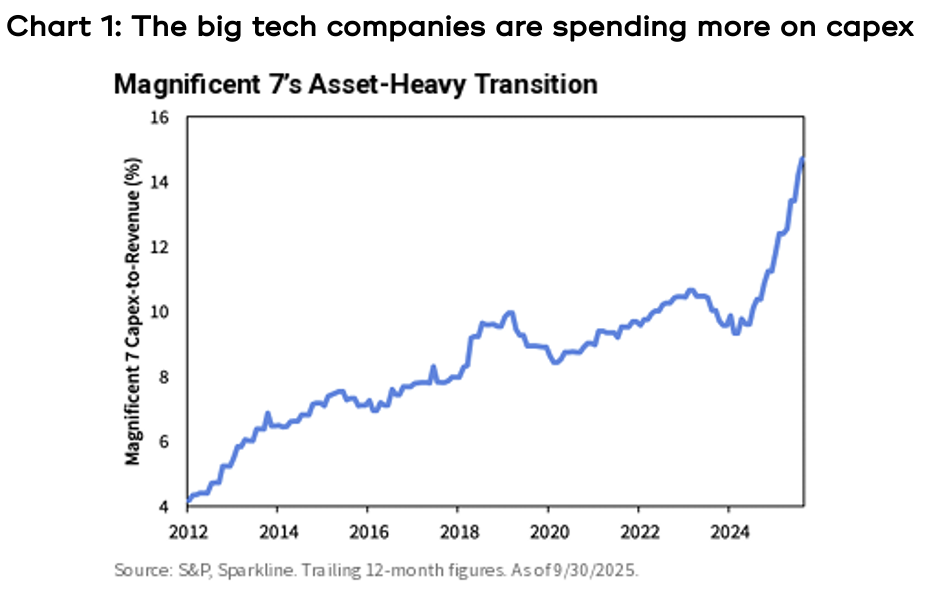
The year kicked off with the US fourth quarter 2025 earnings reports, and all the big AI companies, like Microsoft, Amazon, Meta and Oracle caught the market by surprise by announcing that, combined, they’re looking to spend almost US$700 billion on things like new AI data centres, which will chew up an estimated 90 per cent of the cash they generate – see chart 1.
In the past those torrents of free cash flow had supported elevated valuations for the mega cap tech stocks, partly because a lot of it was used to buy back shares.
Since the GFC, valuations for companies like Microsoft and Meta got a boost from their asset light business models. For example, when Microsoft has a software update, it doesn’t need to build factories or deploy lots of delivery trucks, customers just click a button. That makes for extraordinarily profitable companies.
But that’s changing now, with the tech giants locked in an apparently existential, and very expensive, battle for AI pre-eminence. All those pristine profitability measures like return on equity are headed south, and investors aren’t sure where they’re going to stop.
Tech giants at risk of underperforming
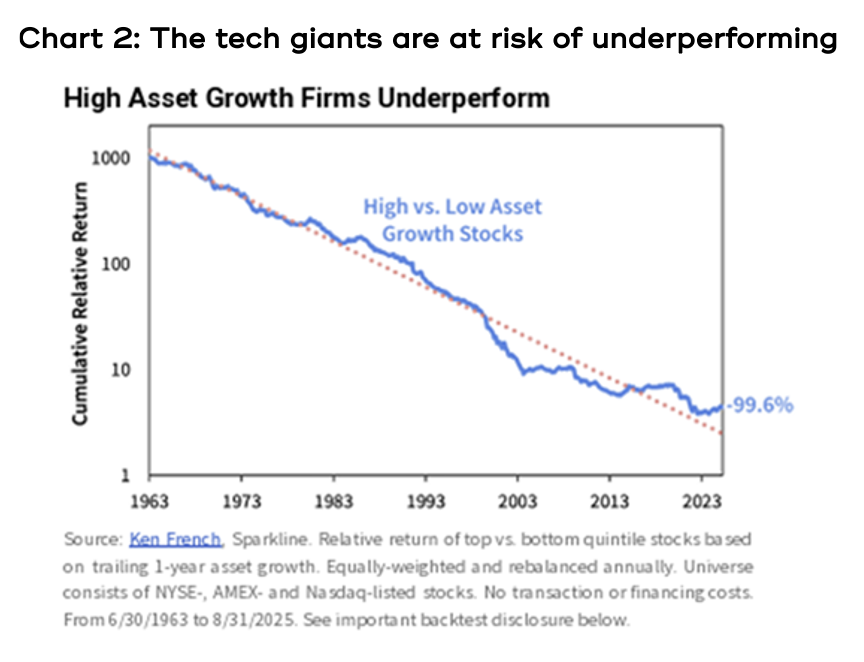
A very clever US fund manager, called Kai Wu at Sparkline Capital, analysed what has happened in the past to companies that changed from an asset light business model to asset heavy. He found that since 1963, companies that aggressively grew their balance sheets underperformed their more conservative peers by a considerable 8.4% per year – see chart 2.
A broadening of returns
Over the past three years, if you weren’t invested in the Magnificent 7 giant tech companies, it’s likely your returns out of the international portion of your portfolio were a bit undercooked. However, the reason the US market hasn’t collapsed under the weight of the US tech selloff is because money is now flowing into those parts of the market that had previously not done much at all. In fact, from the start of 2025 to 3 November, when the tech shares collectively peaked, the top 100 stocks in the S&P 500 contributed 88 per cent of total returns, but since then, to the end of January 2026, they contributed only 24 per cent. Another way of illustrating the point is to look at the performance of the usual market weighted S&P 500 index, where a share’s contribution to the index’s returns is determined by the size of its market capitalisation (i.e. number of shares x the share price), compared to the equally weighted index, where every stock has a 0.2 per cent weighting. If the equally weighted index is outperforming the cap weighted, it’s a sign that, instead of being reliant on a handful of mega cap giants, returns are broadening out, which is a very healthy sign for the overall market – see chart 3.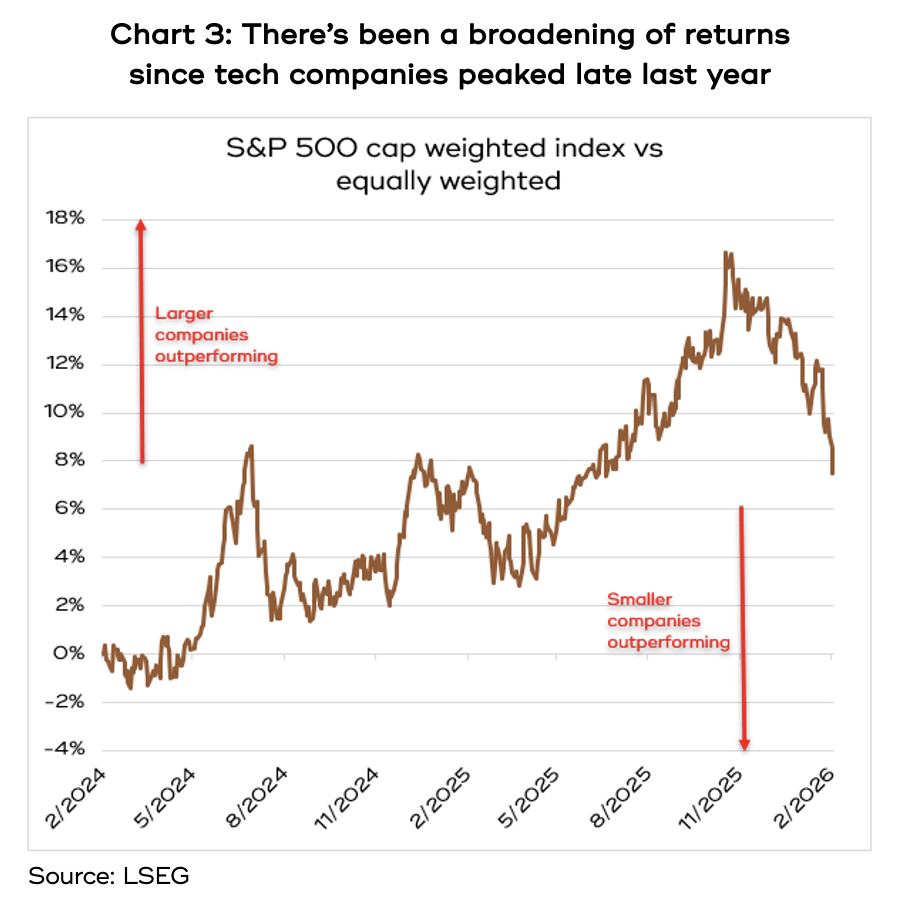
Smaller companies benefiting as well
Just like the smaller members of the S&P 500 have been outperforming the bigger ones, small cap companies across the globe have been outperforming their large cap peers for the first time in years – see chart 4.

Where else is the money going?
For the first time in years, the other international markets are outperforming the US. Both the developed nations ex the US, so essentially Europe and Japan (which is referred to as EAFE), and the emerging markets, started outperforming from the beginning of last year – see chart 5.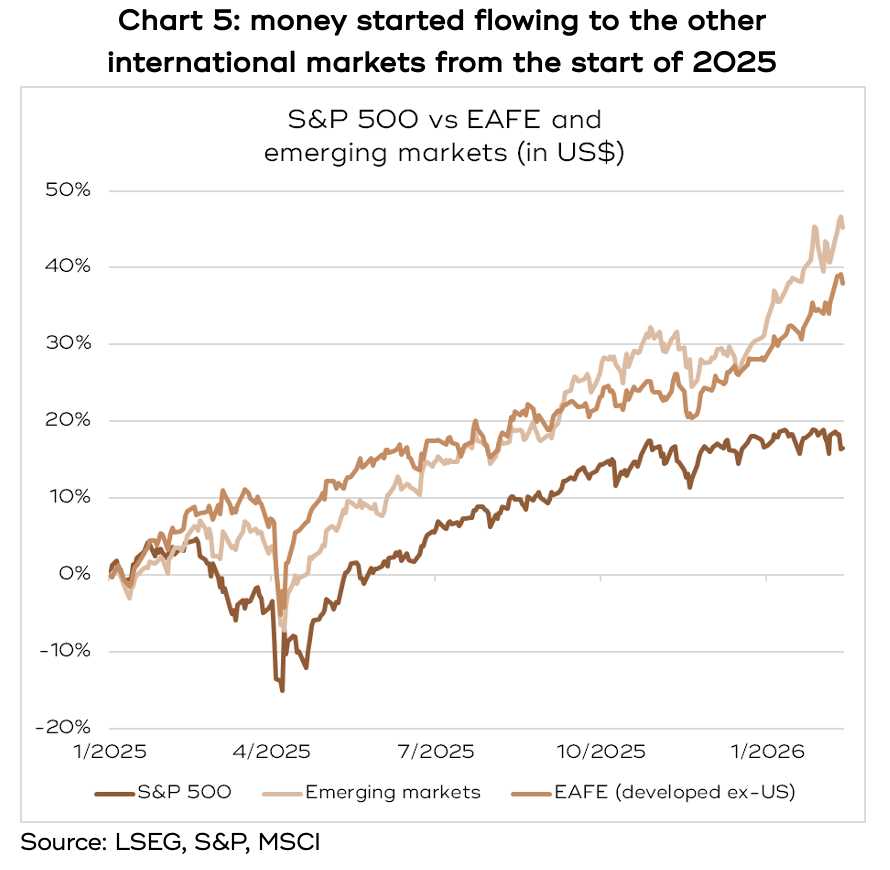
There are a few possible explanations as to why this rotation started last year, including that those other markets were significantly cheaper than the US, and the US$ started to devalue soon after Donald Trump was elected as the US President.
A legitimate question to ask is how much further those rotations can go. Chart 6 puts the recent move in the emerging markets into a long-term perspective: the last 50 years has been characterised by cycles where the emerging markets significantly outperform the developed markets and then give it all back.

Value vs growth
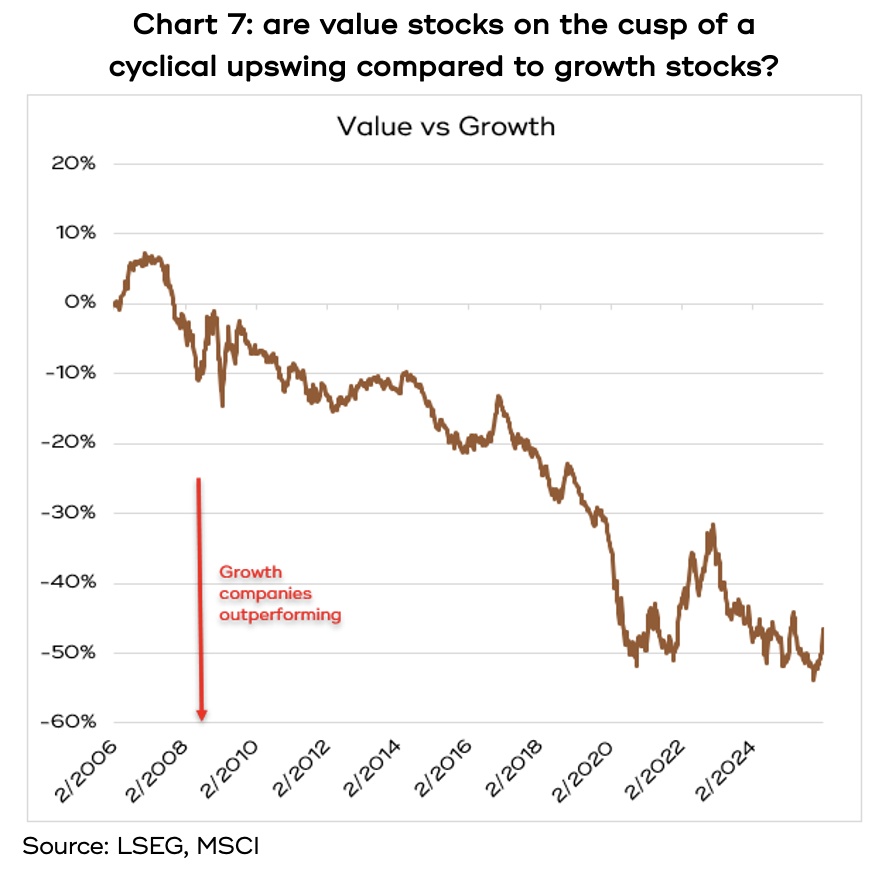
There has also been a rotation away from the growth stocks, like tech, back to value stocks, which are those whose earnings are more leveraged to the economic cycle, like industrials and resources. Chart 7 shows growth stocks have smashed value over the past 20 years, with the inexorable rise of the US mega cap tech companies. But just recently value has turned.