
2025 – The scorecard
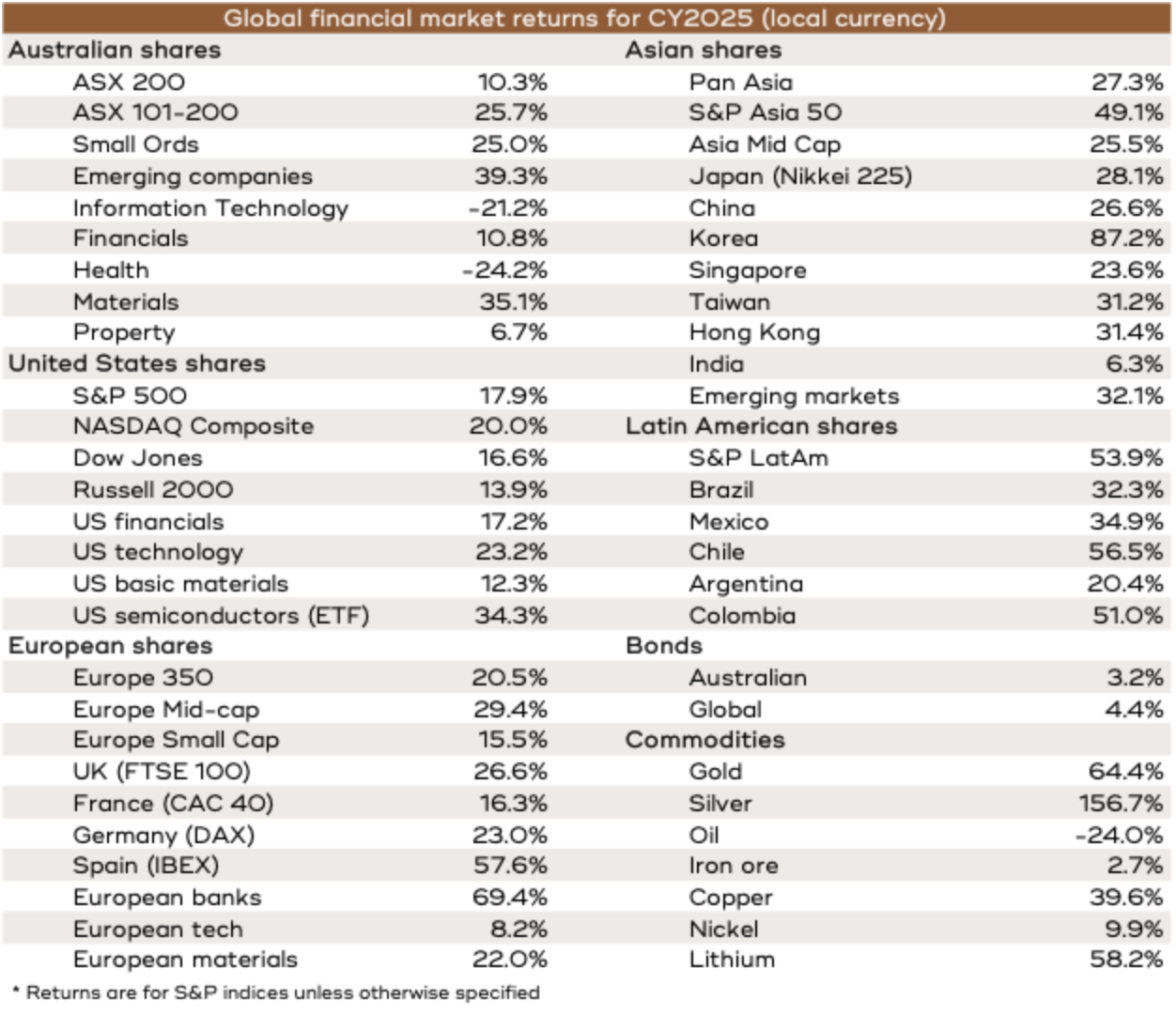
2025 saw another year of strong returns across financial markets, but it was more remarkable for how different it was to the last few years.
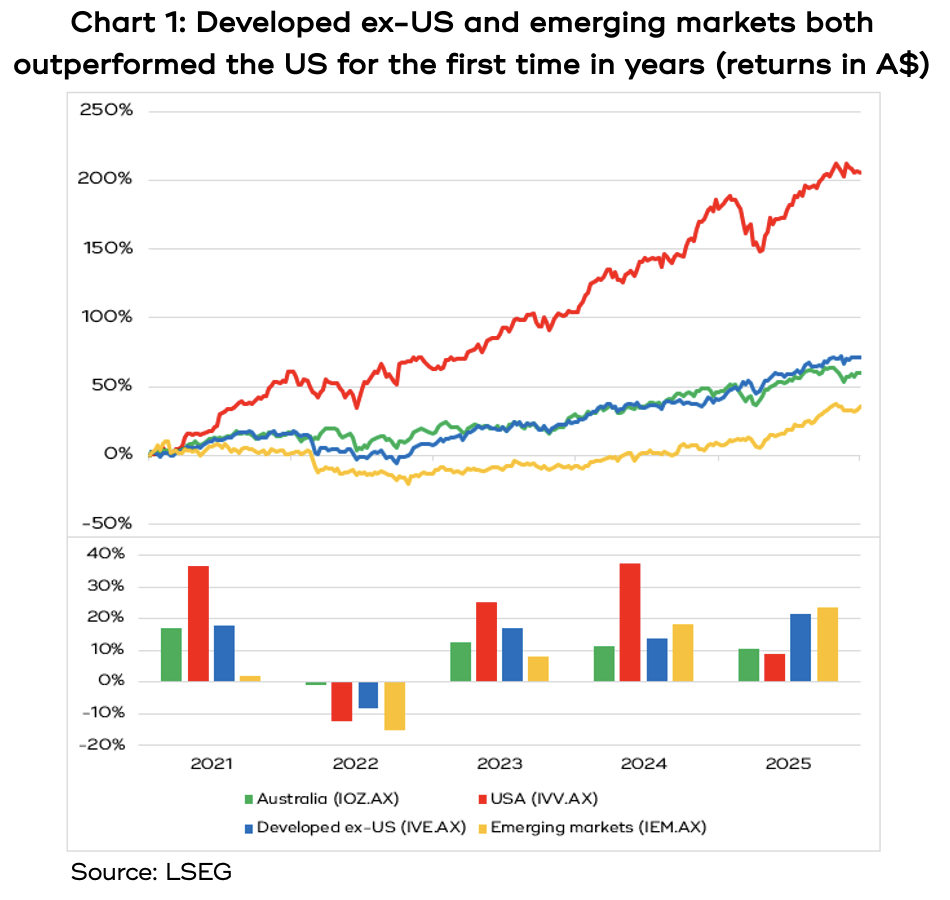
Over the previous 10 years, if you weren’t invested in US shares, and more specifically US tech, you felt left behind, but in 2025 the US market was an also-ran. The developed international markets ex the US, basically Europe and Japan, saw their best performance compared to the US in more than 30 years, and the emerging markets did even better – see chart 1, though as the chart shows, they have a long way to go to catch up on a five-year cumulative return basis.
But trouncing all of them were some of the commodities, which had been absolute duds for years, with gold and silver shining (pardon the pun).
The returns from some individual, usually smaller, markets were astonishing. The Korean index rose by 87%, with Samsung almost doubling and SK Hynix tripling on semiconductor demand. Three other markets rose by more than 50% in the year: Spain was up 57%, with European banks rising 69% over the year, 56% from Chile and 51% in Columbia.
Regrettably, once again, the Australian market was one of the lower returns at 10%, but under the skin, the resources stocks are back, with the materials index rising by 35%.
Cheaper markets caught up
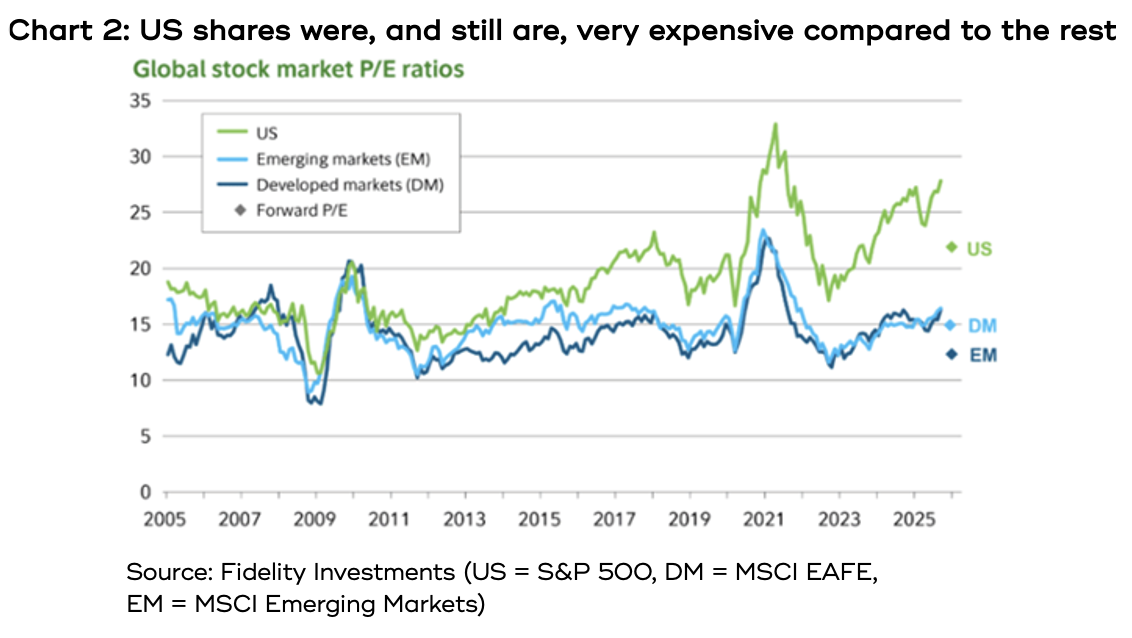
After years and years of markets ignoring the fact that US shares were hugely expensive compared to Europe and the emerging markets – see chart 2, suddenly it mattered, and the cheaper markets started playing catch up.
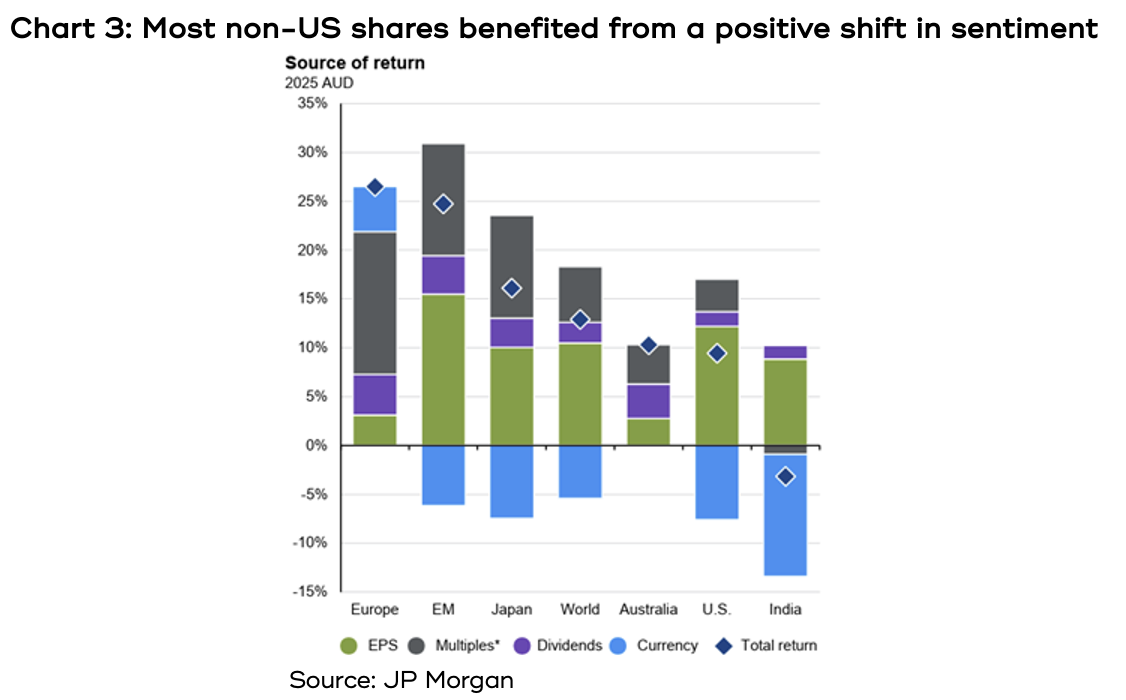
There are all kinds of reasons why US shares trade on a higher PE ratio than their international peers, which we’ve written about extensively in the past, but chart 3 below shows how sentiment turned in favour of the cheap non-US markets last year.
The columns show the total returns of different regions, and the colours represent the various components of those returns. All share market returns can be broken down into three elements: earnings growth (in green), dividends (purple) and change in sentiment, represented by changes in the price to earnings (PE) ratio (grey). (The blue portion is the effect of changes in the A$).
Earnings growth is by far the most important long-term determinant of share market returns, but in the short-term, it can be trounced by sentiment. This was on full show last year: US earnings growth over the year was strong at 12%, far better than Europe’s 3% and Japan’s 10%. But the total return was considerably less, all because of sentiment.
If sentiment becomes more positive, the grey bars will be above the 0% line, and vice versa. You can see that, for example, last year, a more positive sentiment toward European shares accounted for about 15% of the 22% return (before accounting for the effect of currency movements), which is a huge proportion. Likewise, for the emerging markets it was about 11% of the total 31% return – not as much, but still substantial. By contrast, for the US, it was about 3% out of 13%, and strikingly, the PE ratios for some of the big tech companies went down over the year.
The not so Magnificent 7
Since the launch of Chat GPT on 30 November 2022, the mega cap tech stocks have dominated US share market returns, such that they came to be called the Magnificent 7 (Amazon, Apple, Google, Meta, Microsoft, Nvidia and Tesla) – see chart 4.
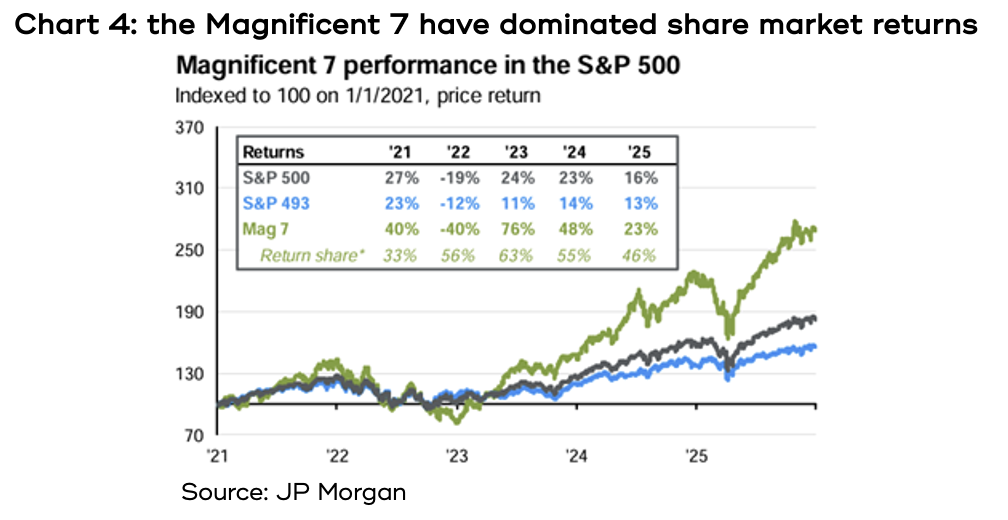
And justifiably so given their spectacular earnings growth compared to the other 493 stocks in the S&P 500 – see chart 5.
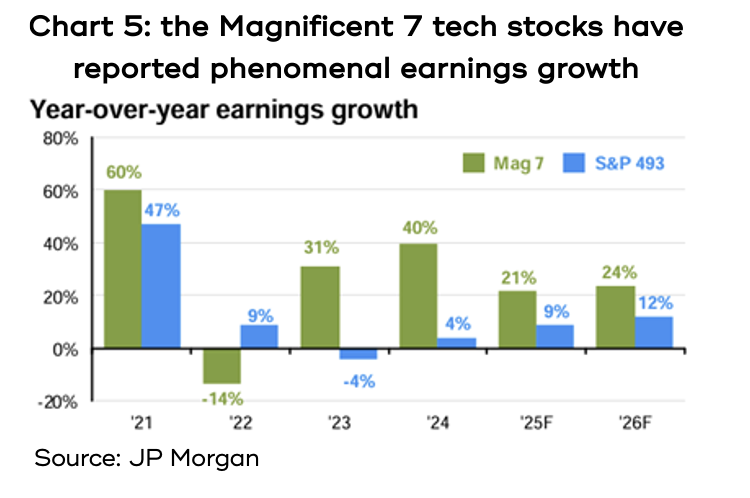
By the start of 2025, the tech stocks the market was focusing on for the buildout of AI had expanded beyond just seven, and the narrative turned to the AI Hyperscalers. The biggest companies in the S&P 500 dominated returns post the April “Liberation Day” selloff, but by the end of the year, that started to change, with only two of the Magnificent 7, Google and Nvidia, delivering a better return than the S&P 500 index. In other words, by the end of 2025, the US market’s returns were being generated by a broader cohort of stocks than just a handful of giant tech companies.
This broadening of returns is a very positive market development and is illustrated in chart 6, which compares the returns of the market cap weighted S&P 500, that is, the biggest companies have the biggest weighting in the index and therefore have the biggest effect on returns, to the equally weighted S&P 500, which means every company has the same weighting of 0.2%, meaning they all have the same effect on returns. After peaking in late October, the tables turned and the equally weighted index did better.
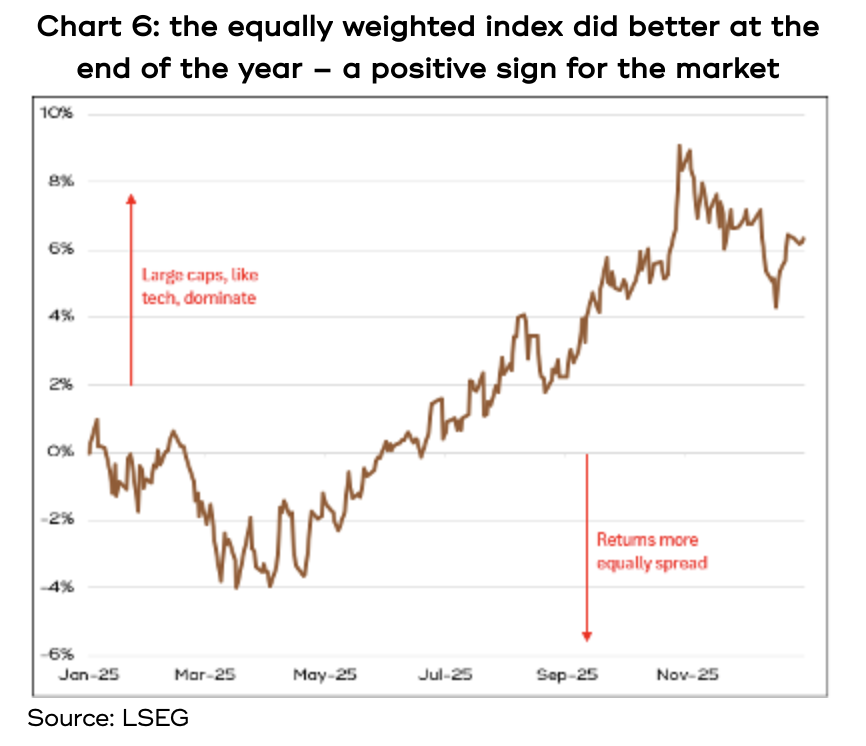
There are a couple of possible explanations for this: the market became increasingly cautious about the amount of money being spent by some of those tech companies jostling for position in the race to rollout AI, something we wrote about, and the market shifted to looking for companies that were benefiting from AI, rather than those rolling it out.
Trump and commodities
You might be as surprised as I am that it’s taken this long to mention US President Donald Trump, whose presence loomed large across the world’s headlines throughout the year.
One of his many campaign promises was to use tariffs as an integral part of his Make America Great Again program, and on 2 April, which he dubbed Liberation Day, he announced a set of tariffs that shocked the world, not just for the size of them, but for how clearly capricious they were – he famously imposed higher tariffs on a set of islands inhabited solely by penguins.
The flow on effects of this have been manifold. First, US importers had anticipated higher tariffs following the November 2024 US election and raced to stock up inventories before their introduction. That meant lots of demand to buy US dollars to settle those deals. Then after Liberation Day, there was initially another surge of stocking up, but then the US dollar weakened significantly and by the end of the year, the US dollar index had fallen by 10% - see chart 7.
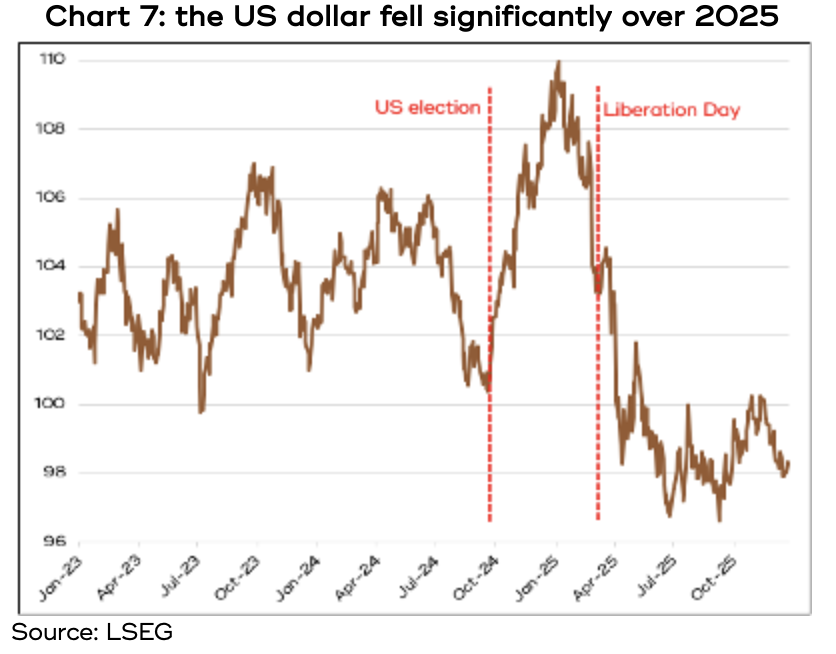
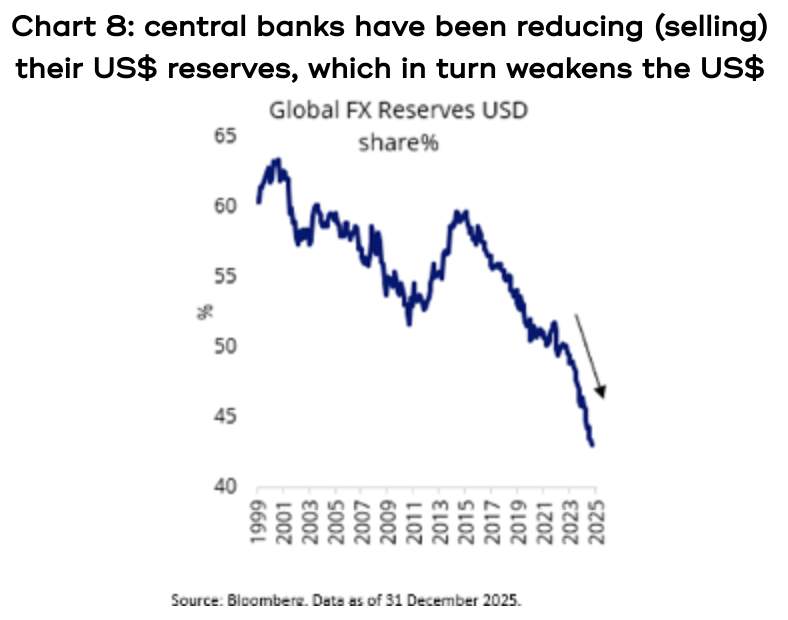
You can point to a few possible reasons for the US$ weakness. First, countries are wary of the capricious and mercurial manner that US economic policy is being conducted under the Trump administration, so are happy to reduce their US$ holdings. Second, some countries are mindful of the sanctions imposed on Russia post the invasion of Ukraine and the freezing of foreign reserves, which has made them look for alternative assets to hold, like gold. Overall, central banks have been reducing their US$ reserves, as shown in chart 8.
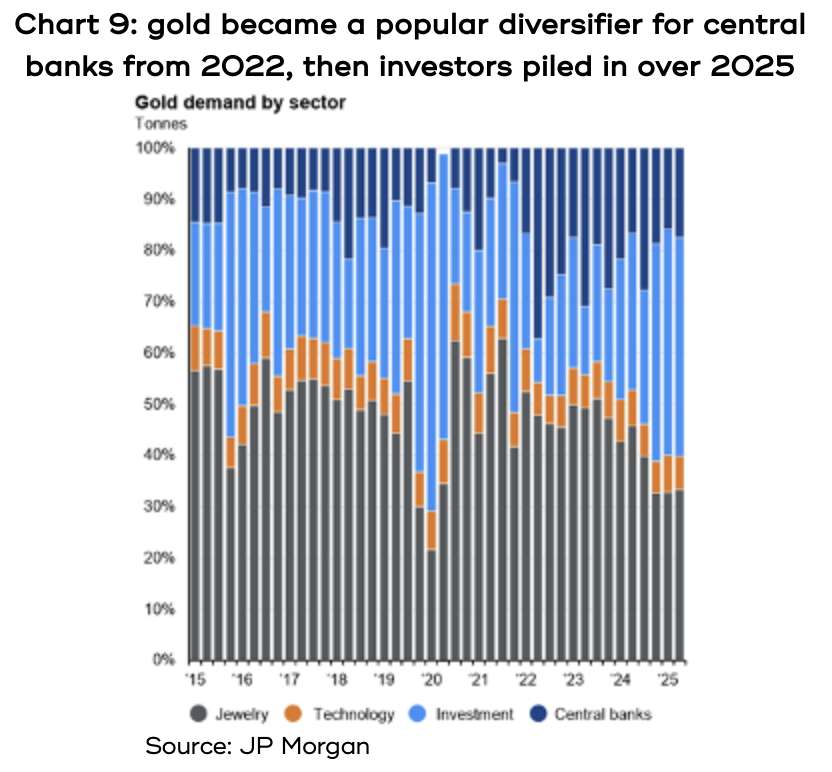
One asset central banks have been buying for the past few years is gold. Chart 9 shows central bank buying averaged about 10% of total market turnover between 2015-2022, but since then, has averaged closer to 20%. Then, from halfway through 2025, investors began piling in, accounting for almost half the total turnover.
That increase in demand saw the gold price climb more than 60% last year. For much of 2025, the silver price kept pace with gold, but by September it went into a different orbit, with the price rocketing by 90% in the final six weeks of the year, for an annual return of 160% – see chart 10.
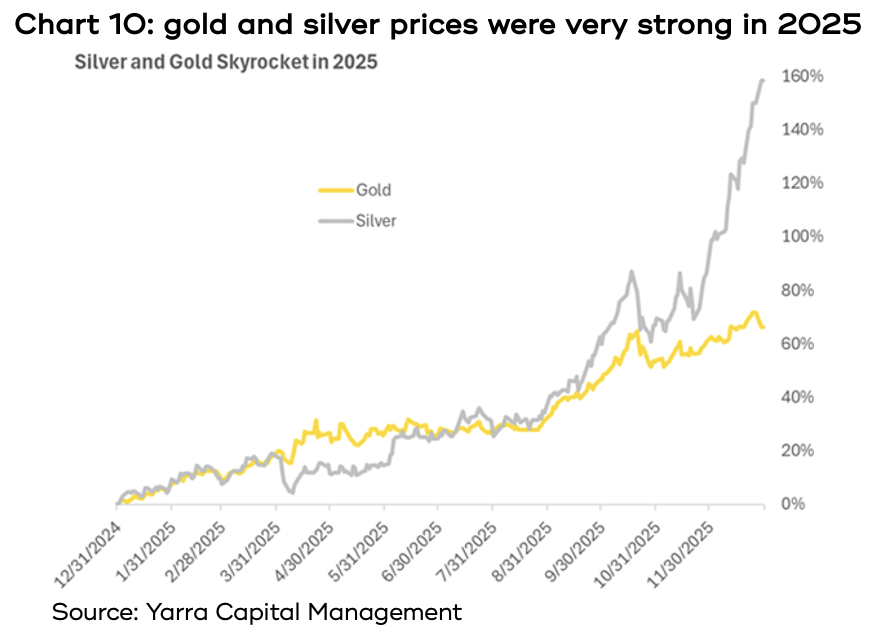
There are several reasons put forward to explain silver’s extraordinary rise. First, precious metals are sometime used as a hedge in times of geopolitical tension, however, it’s not difficult to find examples where that has not been the case. Second, a principal use of silver is in EVs and solar panels, the production of which has been increasing sharply, particularly out of China. And third, that kind of price increase attracts traders who chase the momentum, then, toward the end of the year, China, which dominates silver refining, announced export restrictions that significantly tightened supply and forced a spate of short covering – an explosive combination.
Other commodities also saw significant price movements over 2025. Trump’s attempts to impose punishing tariffs on China resulted in retaliatory restrictions on the export of critical minerals, also referred to as rare earths. You’ve got to hand it to the Chinese; they played a blinder on this. Clearly they had anticipated the tariff moves from the Trump administration and were well prepared. It didn’t take long for the US to back down, having reached a keen appreciation how important those rare earths are for all kinds of technology.
The combination of the US-China trade spat, and the inexorable increase in demand for the metals that help drive the energy transition, such as copper, nickel and silver, helped to shine a light on how tight the supply of some of those metals is, and the weaker US$ helped underpin rising prices.
The only major commodity whose price was markedly weaker over the year was oil, which also helped reduce inflationary pressures.
Interest rate tailwinds
Major central banks around the world delivered 32 interest rate cuts in 2025 with emerging economies cutting a further 51 times during the year, thanks to declining inflationary pressures. Those lower rates helped to propel share markets higher, along with the expectation of more cuts to come.
Australia
The ASX 200 returned 10.3% for the year, not bad, but not great compared to the rest of the world.
The contrast to 2024 was stark. Whereas CBA was the single biggest contributor to the previous year’s returns, 2025 saw the world’s most expensive bank start the year around $150 and peak at just over $190 per share, at which point it started a grinding decline to finish at $160.
CSL, another top 10 stock that had led the market higher only a few years ago, continued its fall from grace, dropping 38% after reporting disappointing results.
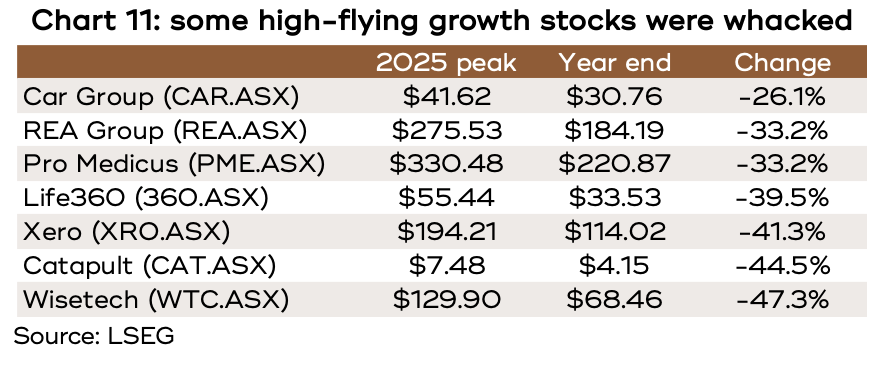
The wind that fell from the US tech stocks’ sails during 2025 also hit Australia’s once high-flying growth stocks. Market darlings that have enjoyed stellar share price increases over the past few years, resulting in some pretty fancy valuations, were summarily dumped - see chart 11.
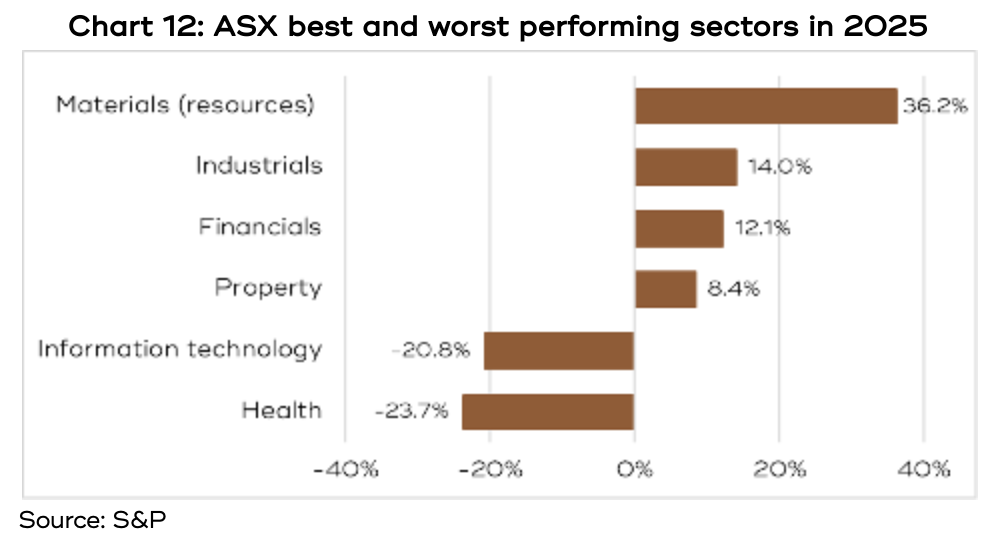
By contrast, 8 of the top 10 best performing stocks in the ASX 200 were resources companies, with Pantoro Gold (PNR.ASX), Predictive Discovery (PDI.ASX) and Resolute Mining (RSG.ASX) all increasing by more than 200%. Not surprisingly, materials (which includes the resources stocks) was the best performing sector for the year – see chart 12.
THE OUTLOOK
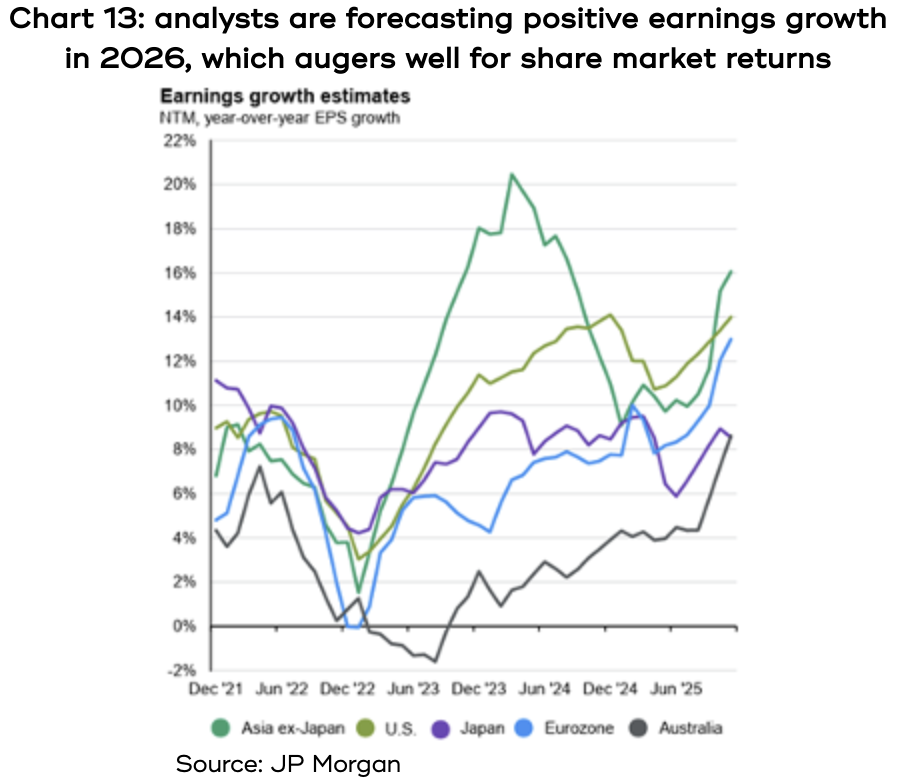
Barring the proverbial ‘black swan event’ that no one sees coming, analysts are generally forecasting another year of positive earnings growth across the major regions, which augers well for a year of positive share market returns – see chart 13.
Geopolitics
When it comes to political events that could blow up in the market’s face, it’s pretty much a case of pick your poison, especially with Donald Trump redefining the expression The Human Headline.
Trump has proven to be mercurial, to say the least, when it comes to conducting policy, both foreign and domestic, or observing established political traditions. There is meaningful risk of a boilover in domestic tensions that could come from any number of areas, such as further controversial ICE actions or the deployment of national guard troops. And, quite remarkably, it remains an open question whether he will decide to invade another country.
The Ukraine war is ongoing, with few signs of a meaningful peace agreement being reached any time soon, and President Putin seems to be escalating his ‘hybrid war’ on Europe.
The Middle East continues to creak under the strain of a myriad of cross currents, and Trump doesn’t hesitate to lob threats that serve to exacerbate tensions.
With all that, you’d think share markets would struggle to overcome the uncertainty, yet it usually does. As we’ve written in the past, share markets will happily look past geopolitical events that you’d swear should shake their foundations as long as company earnings are not being directly affected. As horrible and unsettling as wars or regime overthrows may be, if it doesn’t stop companies making money, the share market will most likely carry on.
If you wanted to spot potential macroeconomic effects from what’s going on, here are a few guesses:
- If Venezuelan oil is allowed to flow more freely and reach international markets, it’s possible the oil price will soften, which should reduce inflationary pressure and make it easier for central banks to cut interest rates, which would be positive for markets.
- On the other hand, if Trump hits Iran and prevents its oil from being exported, you could have the reverse effect.
- If Trump continues to threaten Greenland and disregard the NATO pact, it may encourage Europe to spend more on rearming and infrastructure, which will be a boost to European growth.
- If Trump continues to pressure the Federal Reserve to reduce interest rates, it may continue to put downward pressure on the US$, which will be an ongoing tailwind for both emerging markets and commodities.
Australia
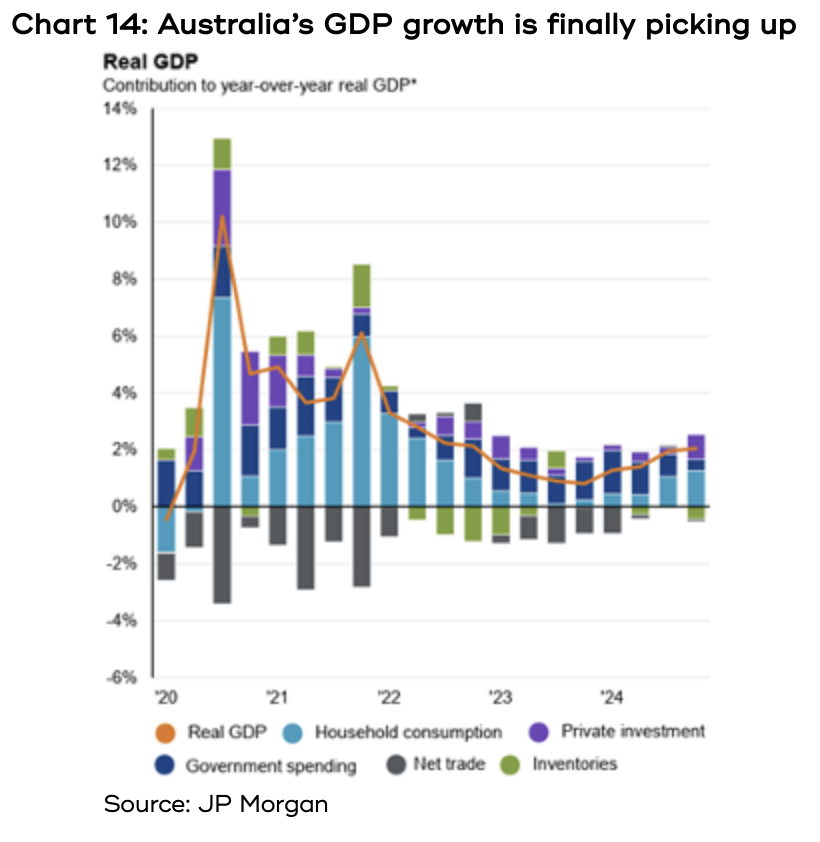
At long last Australia’s economy appears to be spluttering back to life, with GDP per capita finally going positive thanks largely to households being more comfortable spending once interest rates were assumed to have peaked, and private investment picking up – see chart 14. A positive economic backdrop arguably makes more room for earnings upgrades.
The ASX 200 finished 2025 trading on a forward PE ratio, that is, based on what earnings are forecast to be over the next 12 months, of 18.3x, which is down from the recent peak of just over 20x, but still comfortably above the long-term average of about 14.4x – see chart 15.
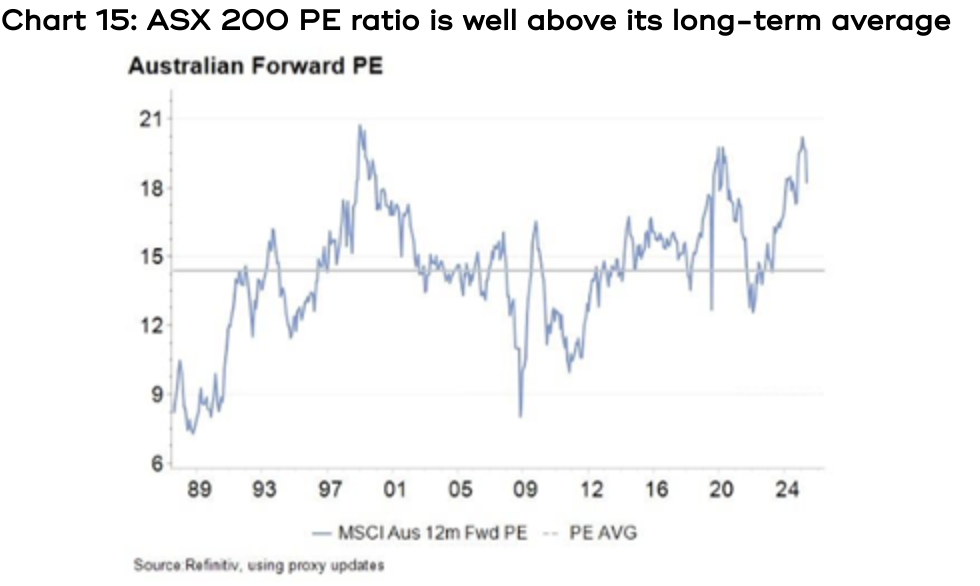
UBS makes a good point that the PE has averaged 17.5x since 2009, and they argue, quite reasonably, that the structurally higher PE could be attributable to changes in the composition of the index with more high growth companies represented, plus companies in general have less debt and higher returns on equity. So maybe 18.3 isn’t especially expensive.
UBS is forecasting only 7.6% earnings growth for 2026 for the overall market, but at a sector level, materials are expected to deliver 13.2% growth and the banks 8.1%.
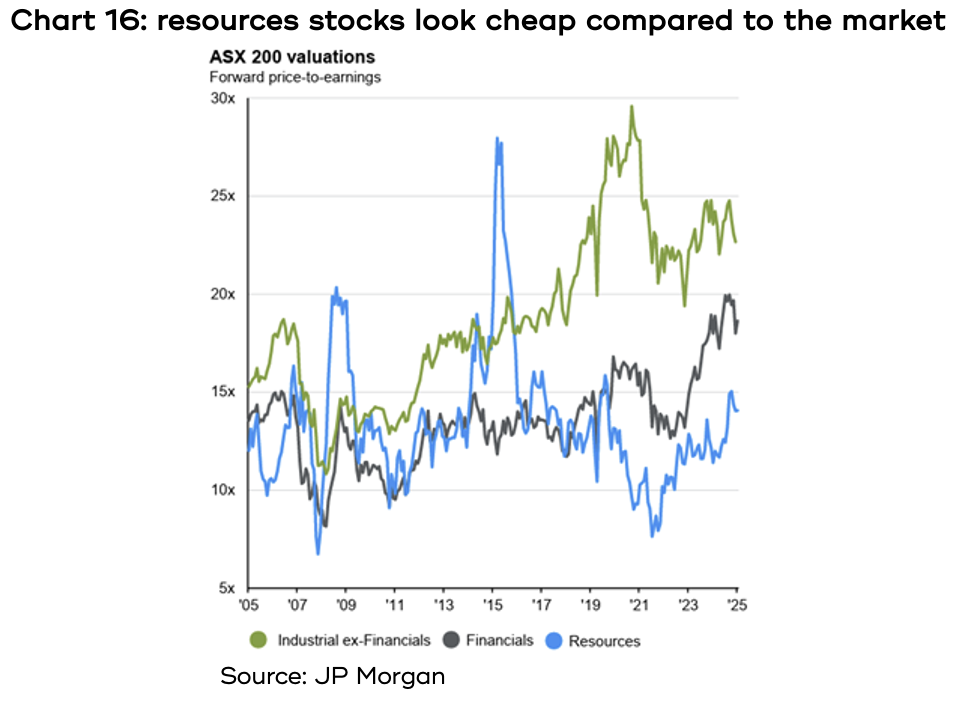
If the market continues to focus on companies and sectors with lower PE ratios, materials could be an ongoing beneficiary. Chart 16 shows the resources’ PE ratio is considerably lower than the industrials and financials, and at 14x, is about 30% cheaper than the overall market and, according to JP Morgan, is only just above its 15 year average (though keep in mind, a big part of that reflects how difficult it is to accurately forecast what commodity prices will do).
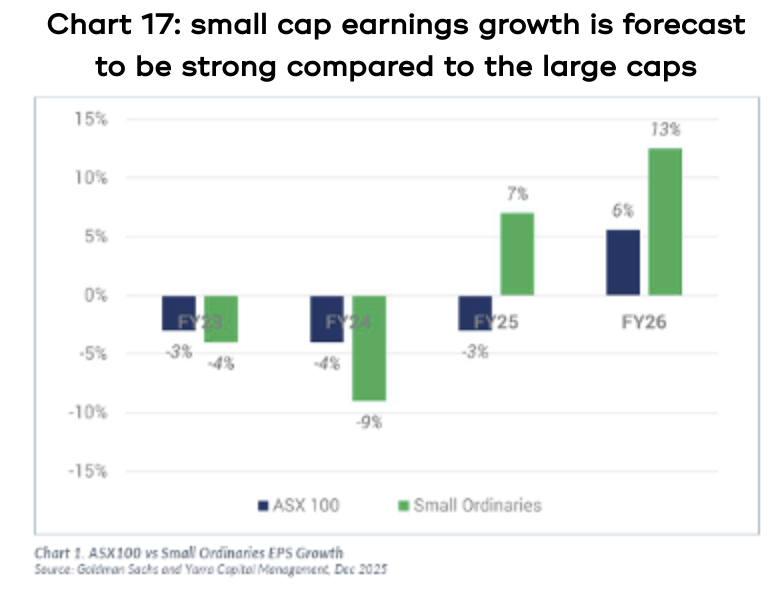
One area that will be interesting to watch is the Australian small cap sector, which had a terrific year in 2025 thanks to the small resources stocks. Yarra Capital points out that analysts are forecasting 13% earnings growth for the small caps in 2026, compared to 6% for the top 100 companies – see chart 17, and with a forward PE ratio of 14.2x, it’s one of the few sectors trading below its long-term average.
At this time, we remain underweight Australian equities due to the relatively underwhelming combination of lower forecast earnings growth and a higher PE ratio but do have a preference for small and midcap stocks.
The United States
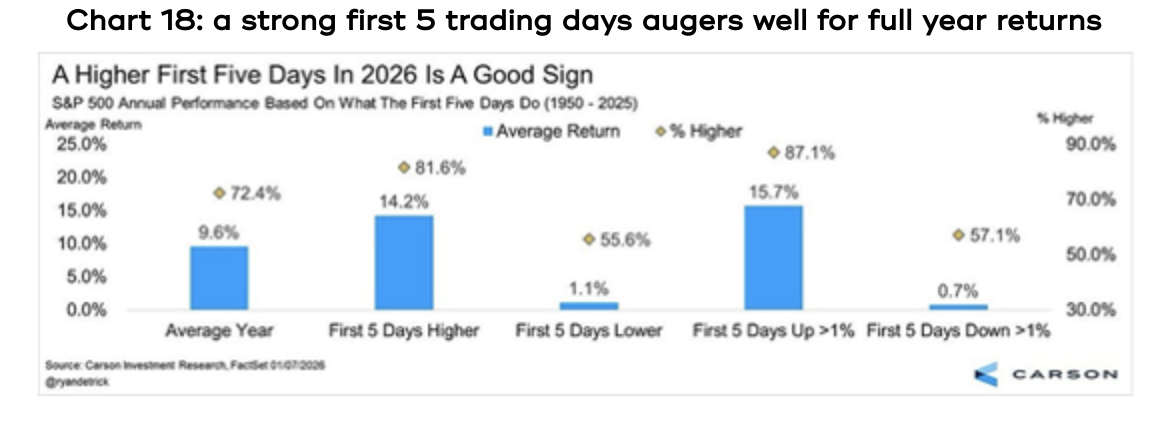
The US share market has leaped out of the blocks to start the year, with the three major indices, the Dow Jones, the S&P 500 and the NASDAQ all trading at, or close to, all-time highs. This augers well for full year returns, because over the past 75 years, when the S&P 500 is up by more than 1% after the first 5 trading days of the year, the full year is positive more than 87% of the time with an average increase of nearly 16% – see chart 18.
After delivering 13% earnings growth in 2025, the consensus analyst forecast for 2026 is for 14% growth. Historically, analysts are pretty good with their forecasts, usually landing within 1% of the final result. So, if you add a dividend yield of about 1.5%, the fundamentals point to a return of better than 15%. But, as we said above, the big swing factor on a 12-month view is sentiment, and that’s impossible to forecast.
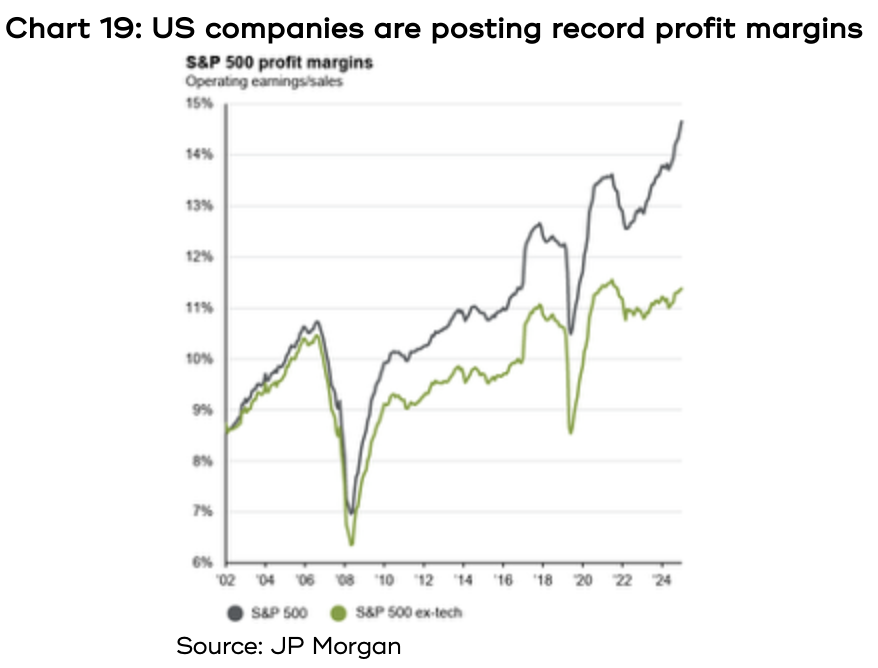
US companies are in great shape, boasting record revenue per employee and record margins – see chart 19.
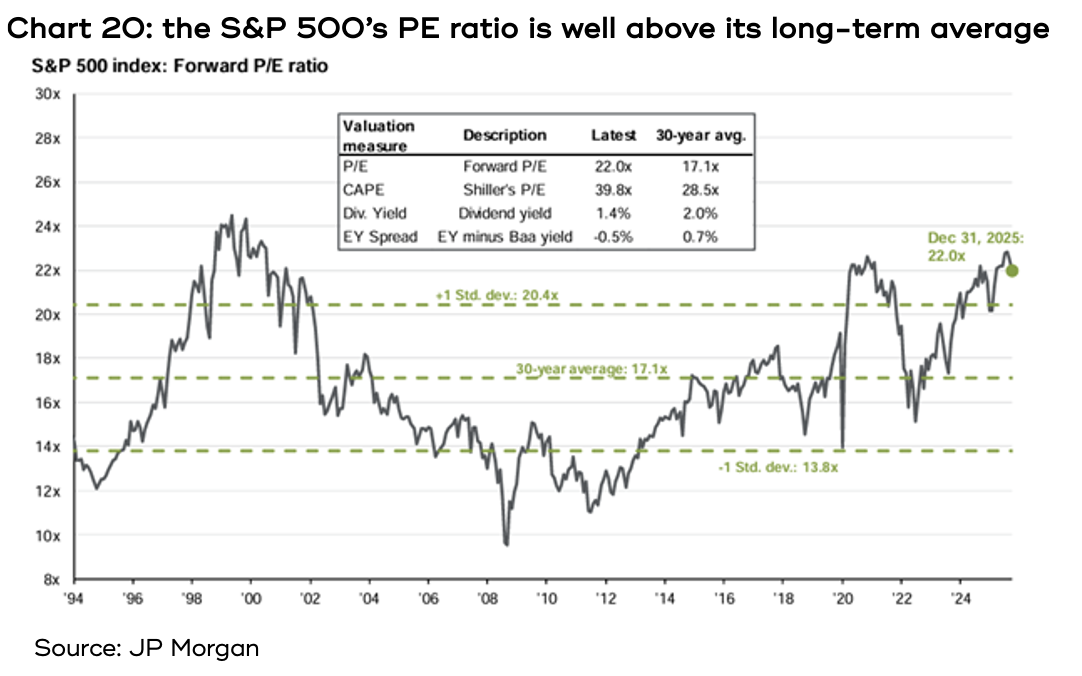
There is ongoing concern that the US is trading on rich valuations, with a forward PE ratio of about 22x, which is comfortably above the 30-year average of 17x – see chart 20.
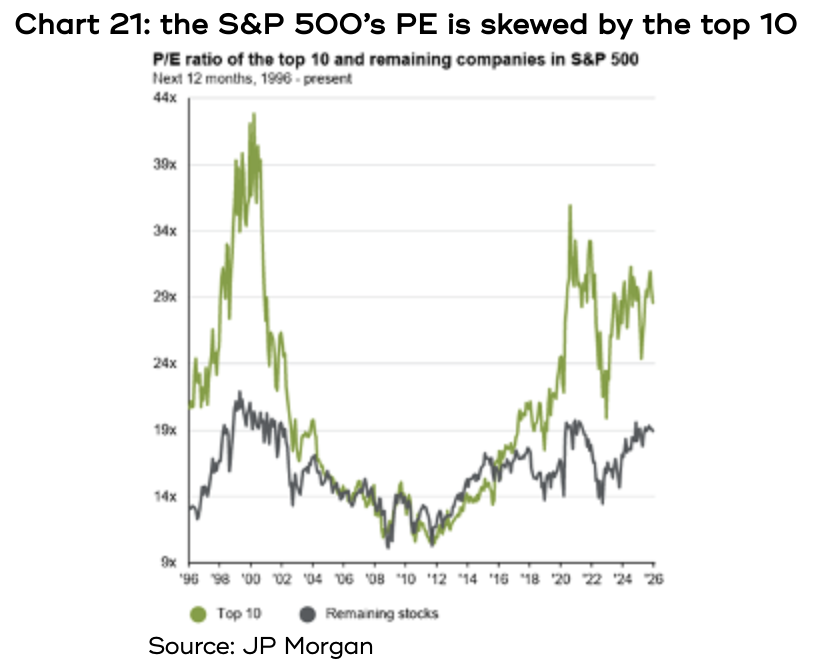
However, we wrote extensively about this in the past: just like the ASX 200, there are similar arguments about the composition of the index and improving quality of the companies that justifies a higher valuation, but we’d add that the S&P 500’s PE ratio is dragged up significantly by the megacap stocks, as chart 21 shows. If you exclude the top 10 stocks, which are trading on an average PE of 25x, the rest of the index is on about 19x.
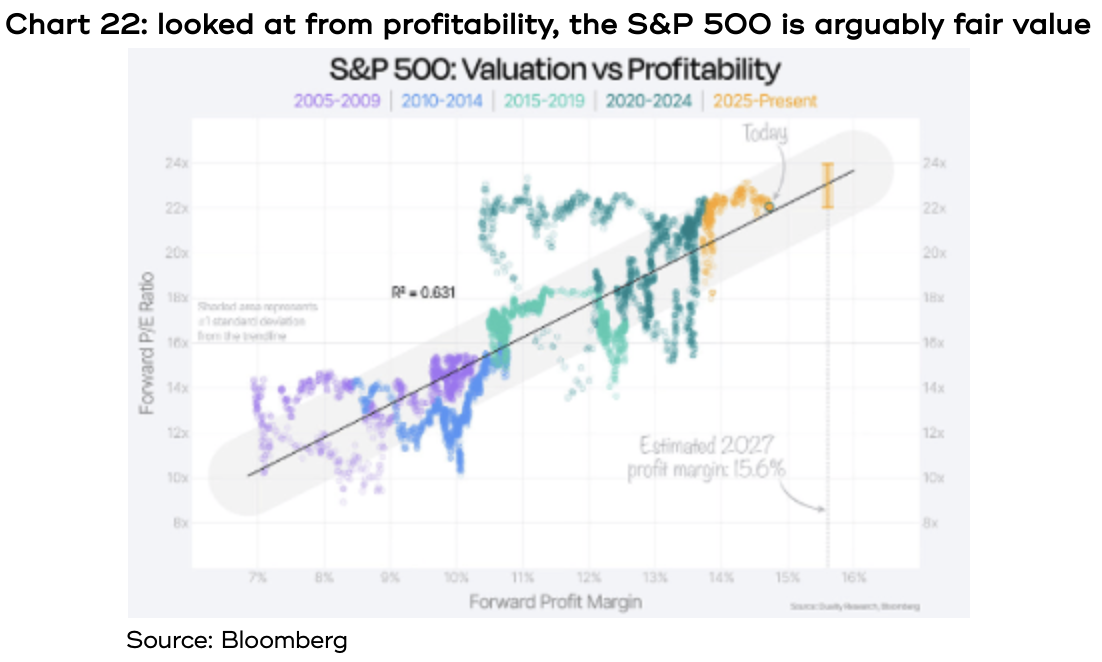
An interesting way of looking at US valuations is, rather than looking at the PE ratio in isolation, to put it in the context of those rising profit margins. Based on corporate profitability, the current market is almost bang on fair value using this measure – see chart 22.
A grab bag of other points that support a positive view of US shares:
- In any year where there is no recession, the likelihood of the US delivering a better than 10% return is 70%. With an expected government budget deficit of almost 6%, which is very expansionary, together with Trump’s One Big Beautiful Bill’s expected 0.9% GDP boost, plus the forecast AI hyperscaler spend of more than $530 billion and the possibility of further rate cuts, the likelihood of the US recessing in 2026 is low.
- The Fed cut three times in 2026, and each time the S&P 500 was within 1% of an all-time high. There have been 14 previous occasions where that’s happened, and 1 year later the index was higher every single time, by an average of 15.1%.
- On 6 January, the Dow Jones Industrials and Transports indices, which technical analysts (those who look to charts for guidance to what happens in share markets) watch closely as an important technical indicator, were both at record highs for the first time on more than a year. Over the past 100 years, that has happened on 13 previous occasions, and on average, the S&P 500 increased by 12.6% over the following year, with an 85% strike rate.
- On 9 January, 90% of the stocks in the Dow Jones were above their 200-day moving average for the first time in more than a year. That’s happened 5 times since 2003, and 12 months later the S&P 500 was up, by an average of 16.1%.
Europe
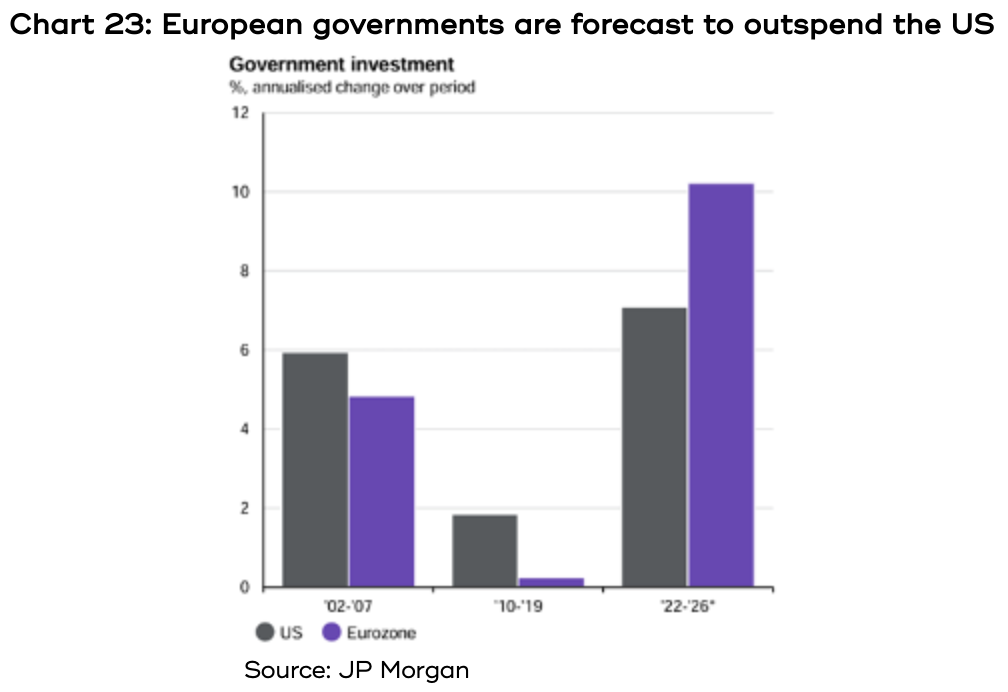
In an unexpected twist, European share markets benefited in 2025 from the US showing every indication they are prepared to abandon the NATO alliance, which would force European governments to spend significantly on defence and infrastructure. That pressure has, if anything, increased since the idea was introduced by the Vice President of the US, J.D. Vance, in February last year, which leads JP Morgan to estimate European governments will outspend the US over the next year – see chart 23. That should be positive for European economic growth.
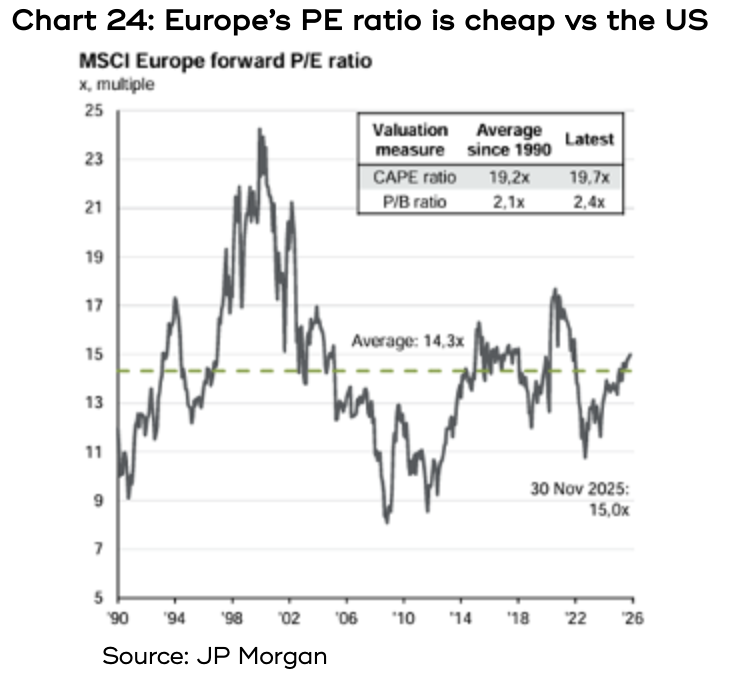
On top of that, if the market’s shift toward value continues, then Europe is well placed, given its current PE ratio of 15.3x is more than 30% cheaper than the US’s, but is not even 7% above its 36-year average – see chart 24. At the same time, forecast earnings growth of 14% is in line with the US (and about double Australia’s).
Conclusion
Despite a few good years in a row, we believe the outlook for global share markets in 2026 is positive.
Last year saw good returns on the back of positive sentiment, and there’s lots of analysis that shows high PE ratios are not mean reverting but tend to correct in recessions. And the likelihood of recession, short of a black swan event, appears low.
If the market continues to pivot toward cheaper stocks and markets, which is a BIG if, then Europe and the emerging markets appear well placed, as do mining stocks in Australia and small and midcap stocks both domestically and internationally.