
It doesn’t seem that long ago that bond yields were so low that for a while there they were actually negative. Yet, despite being guaranteed a negative return, there were investors still buying them. Now, with yields at more than 5 per cent, investors are lining up to sell.
Bond yields’ sharp climb to multi-decade highs has set off a wave of concern: why are they going up and what does it mean for share portfolios?
There's money to be made
For investors accustomed to buying shares, bonds can seem really boring: you just get a yield. Big deal. But that’s not right, you can make very good money if you buy bonds at the right time.
They can also seem like a mystery, but in fact, they’re not all that complicated.
Bonds 101
For the sake of simplicity, let’s stick with government bonds, which are essentially an IOU with an interest rate attached.
A government issued bond, which once upon a time was a physical piece of paper, contains a promise to repay the holder of the bond after an agreed period of time, which can range from a few months to decades, and for the life of the bond, the government will pay the holder interest.
Investors hand over their cash, and in return they get the yield and the promise of their money back on a set date. Pretty simple.
The two most critical things to remember are, first, when a bond’s yield goes up, its price goes down, and second, inflation is like kryptonite to bonds.
price vs yield
If an investor pays $100 for a bond and they hang onto it until it matures, that is the most they will ever get back for it.
However, bonds are an asset that can be bought and sold, just like shares.
Let’s say you paid $100 for a bond that promises to pay a 5% yield, you’ll receive $5 per year in coupons (which is what they call the interest payments on a bond).
Now let’s say you decide to sell it. If economic conditions have moved against the bond since it was issued (discussed below), then a buyer is going to want to be compensated for those poorer conditions.
Because the buyer can only ever expect to get $100 (called the ‘par value’) if they decide to hold the bond until maturity, the only way they can be compensated is by a higher yield, which can only happen if they pay a lower price.
If they pay $95 for the bond, then the yield has gone up from 5% ($5/$100) to 5.26% ($5/$95).
When you think about it, it’s exactly the same as a share. You might buy CBA shares for $150 at which price the dividend yield could be 4%, meaning you should receive $6.00 of dividends. But if the share price drops to $140, and there’s been no change in the forecast dividend, the yield will have gone up to 4.28%.
We always talk about shares in terms of price, because that’s the main variable that changes. But for bonds, the par value never changes, so the main variable is the yield, which is why we always talk about bond yields.
the inflation bogeyman
Because the par value of a bond doesn’t change, if inflation is rising, or more importantly, if investors think the risk is that inflation will rise, it reduces the value of your $100.
The fancy expression is “the time value of money”. If prices are going up, then your $100 is going to buy less in a few years when the bond matures.
Recently, thanks largely to the Iran War hitting an apparent stalemate and Ukraine targeting Russia’s oil refineries, there is a lot of concern that inflation will rise.
The most obvious culprit is the oil price, which of course feeds through to almost every layer of the economy.
But we’ve also seen a vast range of other prices being affected, like fertilizer, meaning food prices could increase, on top of the cost of transporting the food.
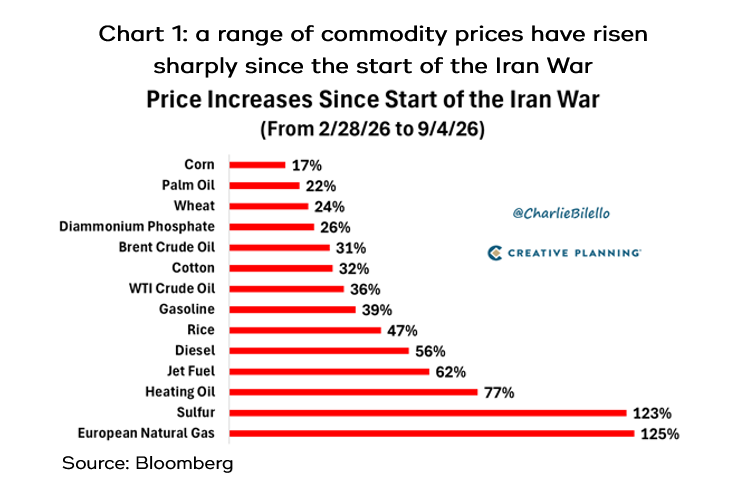
Chart 1 shows how some commodity prices have risen sharply since the start of the war, some of which may be unexpected or surprising.
At the same time, the AI capex boom has not only driven up the price of computer chips, but the insatiable demand for building materials and skilled labourers to build data centres has driven up those prices as well.
And just like it’s not clear when the Iran or Ukraine wars will settle down, nor is it clear how long the AI capex boom will go for.
Consequently, the bond market is seeing a risk of higher inflation for some time to come.
Bond yields at multi-decade highs
The upshot is bond yields are rising across the world, and they’ve hit multi-decade highs – see chart 2.
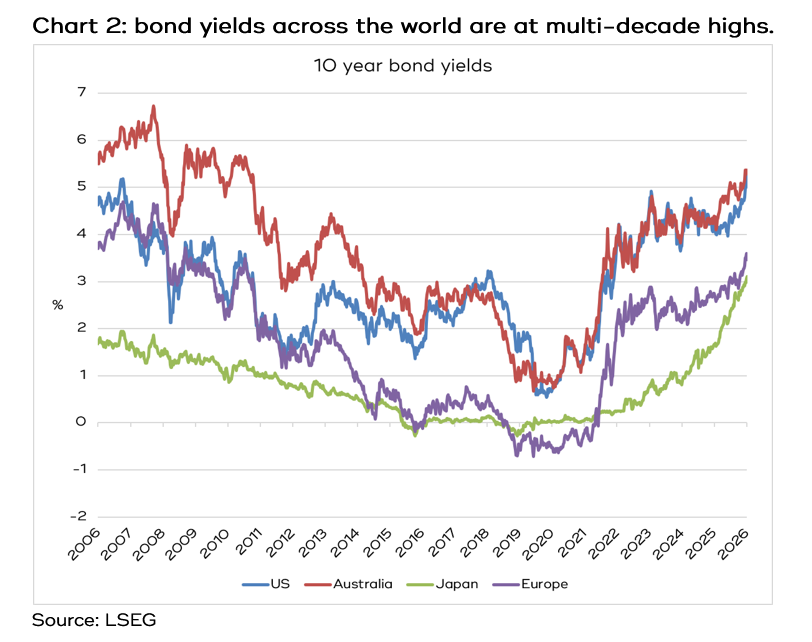
That means investors in bond funds or ETFs have taken a beating, which has only added to the pain that’s been ongoing since COVID in 2020.
Global bond yields bottomed out around March of 2020 and have been rising since, meaning the prices of those bonds have been steadily falling. In fact, the rolling 10-year return for US bonds is the worst it’s been in 100 years. That’s a heck of a galling outcome if you’ve been relying on bonds as the defensive part of your portfolio.
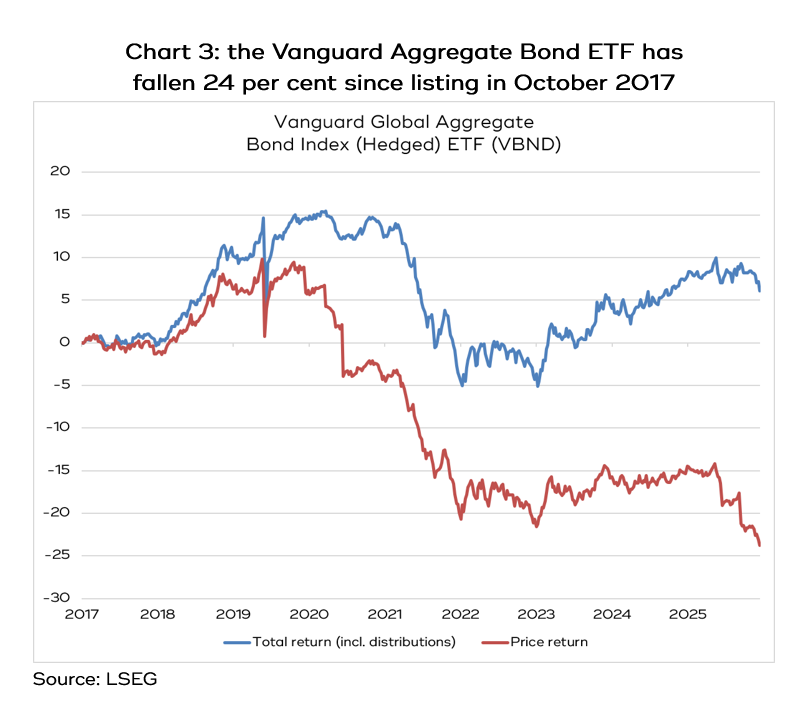
This is well illustrated by the price movements of the Vanguard Global Aggregate Bond ETF (VBND), which trades on the ASX. The price of the ETF has fallen almost 24 per cent since it was listed in October 2017, and even if you include the coupons (distributions), the total return over nine years has been 6.1%, which works out to a paltry annualised compound return of 0.66 per cent – see chart 3.
A buying opportunity?
A smart investor will look at the multiyear fall in the price of bonds and ask is it time to buy? The answer to that depends on whether inflation risks have peaked or are at least close to it.
There’s some comfort that you’ll be getting compensated with a higher yield if you’re a bit early.
what about the impact on the rest of your portfolio?
One of the many ways to try to work how much a share is worth is by using what’s called a discounted cash flow calculation, which takes all the future cash flows you expect from a company and ‘discounts’ them back to today’s dollars.
The discount rate is typically based on the 10-year bond yield, and the higher the yield, the lower is the value in today’s dollars.
That’s particularly relevant for what are referred to as ‘long duration’ stocks, which are those that are reinvesting their cash to build long-term earnings.
The classic example is tech companies, but other rate sensitive sectors are banks, infrastructure and property trusts. Yarra Capital has calculated that 47 per cent of the ASX 200 is yield sensitive, whereas it’s only 16 per cent for the S&P 500.
So higher bond yields could be one of the many reasons Australian shares have underperformed global shares this year.
Another impact is through what’s called the Equity Risk Premium (ERP), which is basically the higher return investors should expect for taking on the added risk of investing in equities compared to bonds. As bond yields rise, the ERP falls, and right now, it too is at multi decade lows.
Rising bond yields, and falling bond prices, are part and parcel of what’s a pretty complex picture right now. But just like any asset class, eventually prices will bottom out, offering a great opportunity.