
When US Hall of Fame financial adviser Ric Edelman calls the traditional retirement portfolio of 60 per cent shares and 40 per cent bonds “downright crazy”, people tend to listen.
His argument is simple: the formula was developed when retirees were expected to live for less than a decade. Today many will need their savings to last 25 or even 30 years.
The 60/40 portfolio dates back to the early days of modern portfolio theory in the 1950s, when the average life expectancy was about 68.
Today it’s closer to 85 and heading toward 90.
If a portfolio has to support a retiree for as long as 25 years, Edelman argues we need to change to something more like an 80/20 default.
Recently a client of ours discovered something surprising.
Because she had turned 63, her industry superfund had automatically shifted her portfolio to 40 per cent balanced and 60 per cent conservative balanced. By age 65 she would be invested entirely in the conservative balanced option.
We were curious to know how that conservative allocation is going to hold up for someone who has aspirations to travel and shows few signs of slowing down.
A little more makes a big difference
At first glance the differences between the major investment options offered by industry super funds do not appear dramatic.
Chart 1 shows the average compound annual growth rates for the growth, balanced, conservative balanced and conservative options of four of the country’s largest funds: AustralianSuper, UniSuper, Aware Super and Australian Retirement Trust, calculated to the end of February 2026.
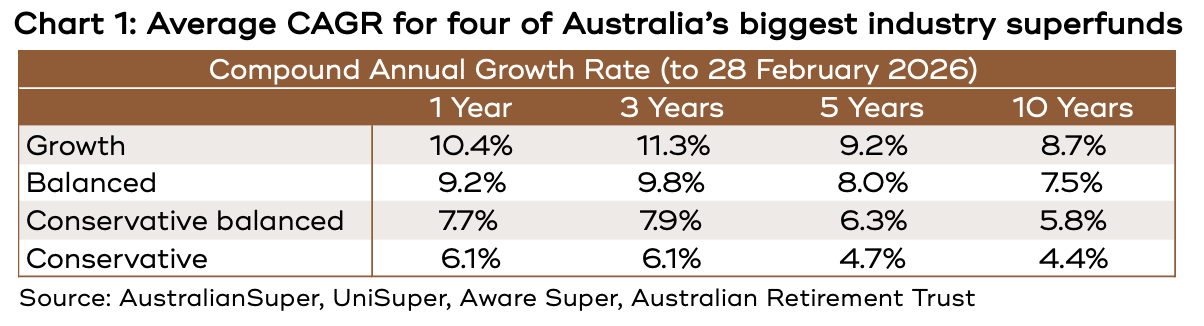
The gap between the growth and balanced options is only about 1.2 percentage points a year over the past decade.
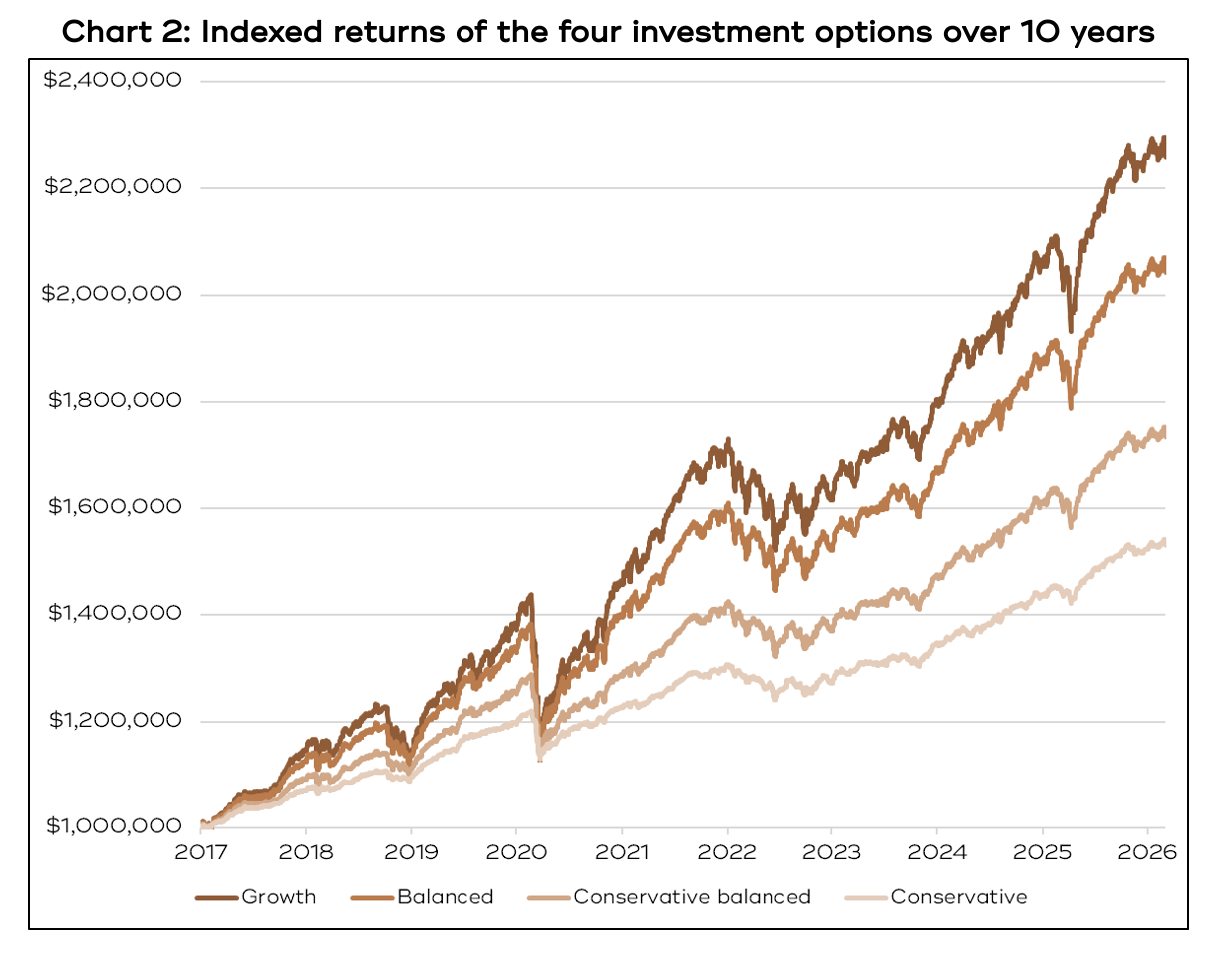
That might sound trivial. But over ten years it leaves the growth investor with a balance more than 10 per cent higher.
The gap between the balanced and conservative balanced options is even larger. Over the same period the difference in ending balances approaches 18 per cent.
Chart 2 shows the indexed performance of these four options over the past decade. What looks like small differences in annual returns quickly compounds into a large gap.
Getting back to square
The reason industry super funds often move investors into more conservative options as they age is to protect their balance from the inevitable corrections financial markets go through from time to time: the higher the exposure to growth assets, like shares, normally the more a portfolio falls in a correction.
But that logic only focuses on one side of the equation: how far a portfolio falls during a downturn.
The other side of the story is just as important: how quickly it recovers.
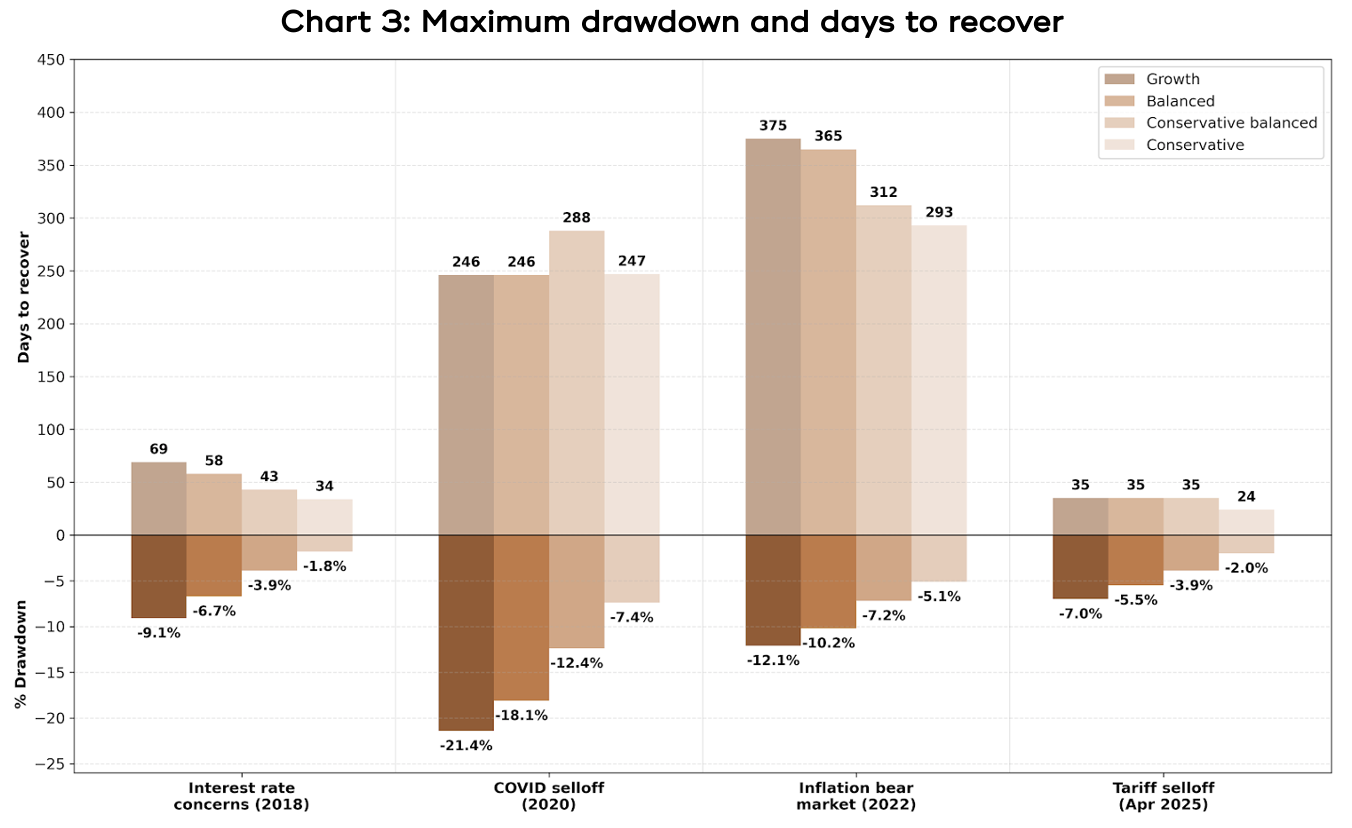
Chart 3 examines four major market corrections over the past decade and measures both the size of the fall and the time it took each investment option to recover back to its previous level.
One result stands out.
During the COVID-19 market crash of 2020 the growth option fell almost three times as far as the conservative option.
Yet both recovered in almost exactly the same time — about eight months.
The inflation-induced bear market of 2022 was arguably a more typical market correction. The balanced option fell by about 10.2 per cent, compared with 7.2 per cent for the conservative balanced option.
But the difference in recovery time was only 53 days — just over seven weeks.
For a patient long-term investor, that is not a particularly long wait.
What happens if you’re drawing a pension?
A concept retirees need to be mindful about is sequencing risk — the danger that markets fall just as they begin drawing down their super.
Withdrawals during a downturn can lock in losses and reduce the capital available for future growth.
So how do these investment options compare if a retiree is drawing a pension?
Chart 4 models the performance of the four investment options over ten years assuming a retiree turned 65 on January 1, 2017 and began drawing the minimum pension of 5 per cent a year, paid monthly and recalculated each June.
Even with regular withdrawals the overall pattern remains similar.
Investors heavily allocated to the conservative option saw their balances steadily erode over the period.
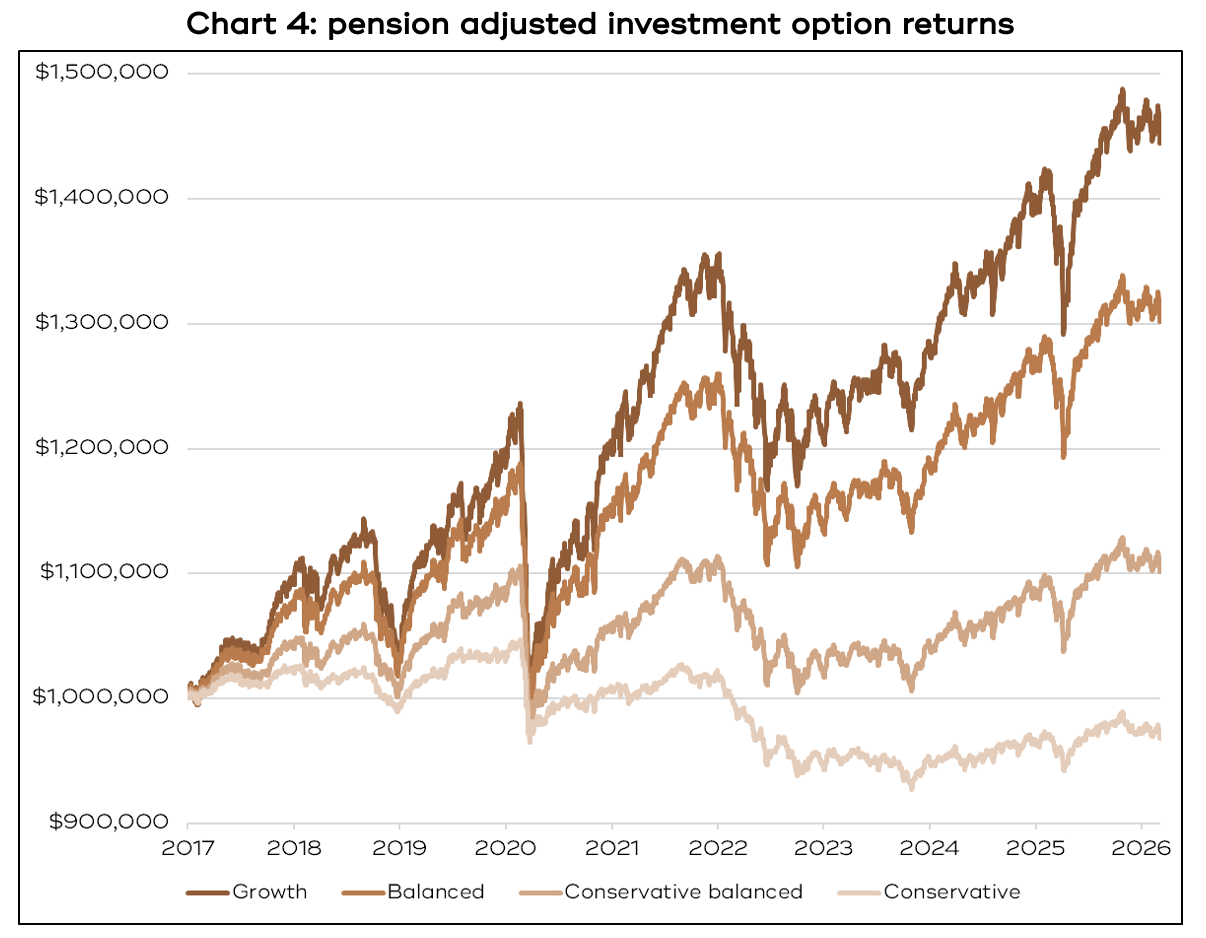
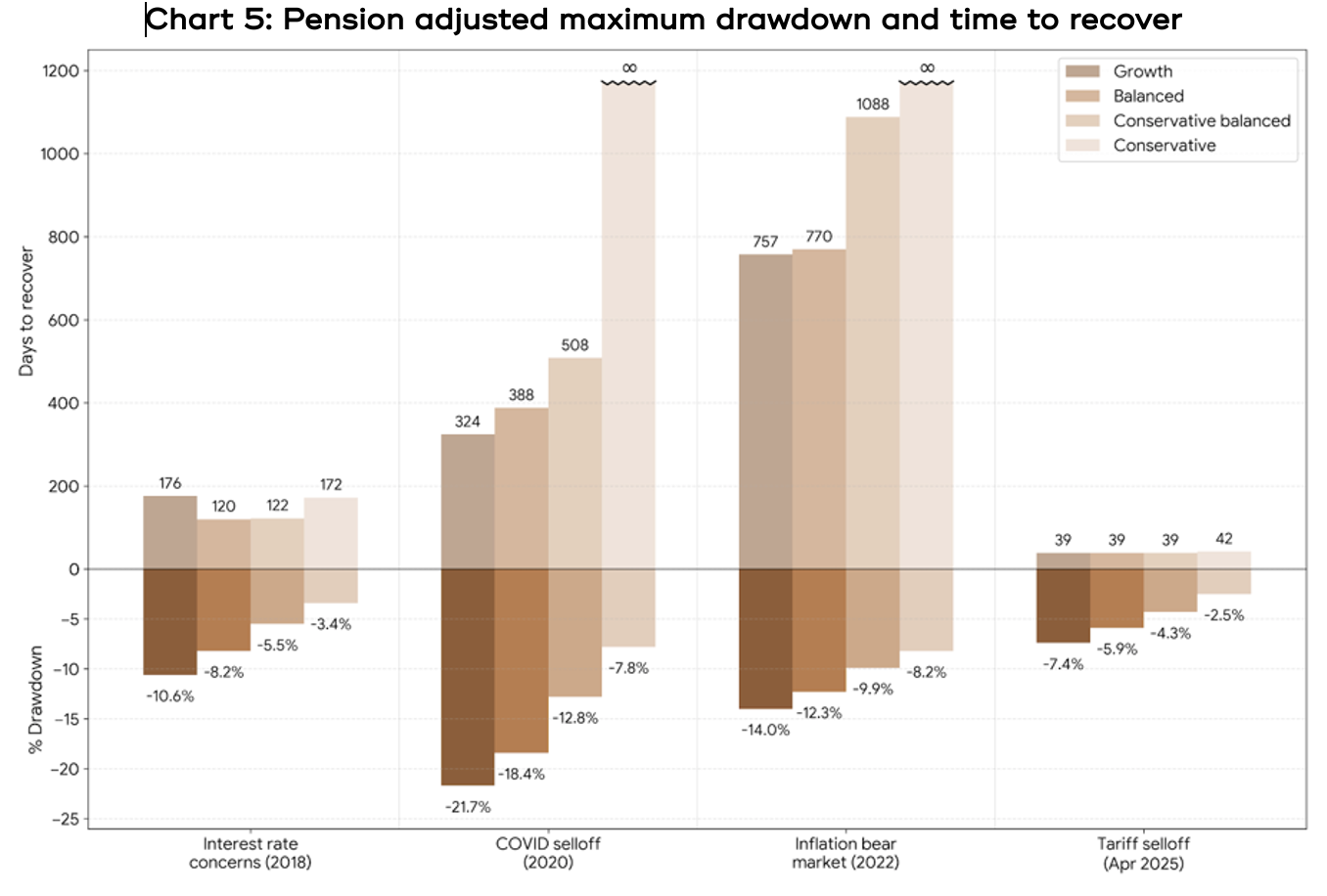
Chart 5 again looks at drawdowns and recovery times under these pension conditions. Once more, investors with greater exposure to growth assets were generally rewarded for their patience.
Under this scenario, during the inflation induced bear market of 2022, the balanced option fell by 12.9 per cent and took just over two years to get back to square. The conservative balanced option fell 9.9 per cent, but took almost three years to recover.
What should you do?
None of this means retirees should take reckless risks.
But the widespread practice of automatically shifting portfolios away from growth assets in our early 60s may be based more on convention than evidence.
For someone who could be retired for 25 or even 30 years, the bigger risk may not be market volatility.
It may be running out of growth.
Every investor’s situation is different. The right portfolio depends on how much risk you can take, how much risk you should take, and how much risk you need to take to meet your goals. To help you think that through you can see the section Understanding Your Risk Profile on our website.
If you’re invested in an industry super fund, the first step is simply to check which investment option you’re in. If you’re in the default setting, make sure you’re comfortable with the mix between growth assets such as shares and more defensive investments like bonds and cash.
For investors who can remain patient through the inevitable market swings, maintaining meaningful exposure to growth assets may prove to be the most conservative decision of all.